How do you change something that’s at the heart and soul of an organization? Cultures that took years to shape are certainly not going to change overnight or as a result of a re-written mission statement and an hour-long speech from the CEO. Cultural evolution takes time. Lots of time.
Transformation initiatives surrounded by the wrong organizational culture and DNA results in an unsatisfied workforce, chaos, confusion, and political collusion.
If an organization’s leadership is unable to inspire its people, how can those leaders expect their workforce to bring initiative, imagination, and passion to their work every day?
A strong, shared sense of purpose also removes many obstacles, and this has to be communicated from the top.
I can suggest you to explore ‘The Persuasion Cycle’ from Mark Goulston. It involves taking people through five stages
From resisting to listening
From listening to considering
From considering to willing to do
From willing to do to doing
From doing to, glad they did and continue to do.
“Ironically, the key to gaining ‘buy-in’ and then moving people through the rest of the cycle is not what you tell them, but what you get them to tell you — and what happens in their minds in the process,” says Goulston.
As he rightly said for any organization the transformation is not what to tell your employees but it’s how you listen to them. It also requires hearing what is unspoken yet conveyed through tone of voice, eye contact, and other body languages. This requires you to be curious and using all of your senses to truly tune into the other person.
Many of you might say you are a good listener, but the reality is we are not. If you analyze yourself you will have to admit that “ you were not actively listening instead, distracted of thinking about what to say next”
This becomes a crucial point when you undergo transformation because you will have to talk to your employees and they will have questions and complaints. You would start the conversation in an active listening mode but it will eventually turn into a defensive and justification mode. This is going to shut the other person’s minds and he will never open up. If your employees don’t open-up then you cant successfully do the transformation. Both of these actions are physiological. You are defending yourself because you yours self is not ready to accept the past, which in-turn will shut the doors to your employees minds.
Why is it important to listen to people: Everyone has their own challenges, needs, desire & agendas( Political & Personal). They have secrets they are hiding from you, they are stressed, busy, and often keeping all of these in their heads.
They put up a mental barricade to cover up all these. You can communicate and transform only if you can overcome this barricade. One of the first steps is to identify these barriers. For that you have to be an active listener with a clear vision of what you want to achieve.
The first step for companies and leaders who are trying to transform is to improve your ability to truly listen. Because the more you know them the more you know the problems. Which will help you in communicating the change you want and you will be able to implement the changes more effectively.
Various civilization has evolved throughout human history. We evolved from “State of Nature” to “Savagery” to “Barbarism” to “Civilization”.
These are the stages we passed through before we reached the apex of any civilization. This also means that the civilization is by default linked with hierarchy, which will eventually get linked with power and politics.
We could see this reflection in almost all the companies. Most of the companies will start small ( State of Nature). During this time they will have the fire to do anything and everything, they don’t care about the status quo, they will be brutal ( Savagery).
Slowly these companies will start growing and the fire will slowly go down. This will slowly lead to not knowing what is happening in each division inside the company and unknown friction starts building up ( Barbarism). This is the period where the companies will realize they need to define the process so they will start building hierarchy, roles, and responsibilities ( Civilization).
This is why I said every company is a true reflection of human evolution.
This means like human history hierarchy will be followed by power and politics. When you observe all the companies which moved to the hierarchical model, the immediate thing to happen will be “ Power game and Politics”.
Like what happened to great civilizations this will eventually lead to the collapse of companies.
You might be thinking what I am saying:
Are you saying that “we should not evolve”.
“NO !, Definitely not !” instead we should learn from the mistakes of what others have made and make sure with civilization you are not losing the element of fire called “Innovation “
Instead of defining specific roles and defining hierarchy for approaching people, we should look at building teams who are empowered to take and act on decisions they make.
Similar to human civilization any company is a group of people and we should not forget human values like Freedom, Friendship, Transparency, Trust, Sense of Achievement, etc.
If you look at the above words then you will understand that you cannot buy those. Instead, those have to be created over a period of time. For that, you need consistency, passion, and care.
I like to call the organization chart a “Power Pyramid” the moment it is established the people will start climbing that pyramid by forgetting human values. When you try to scale you must keep these elements in mind. Because your resources are neither machines nor blind followers, instead they are humans of a civilized world.
We all use the word “ Best “ in our daily life. Not once but many times and on many occasions.
But what is the meaning of this word? According to the Cambridge dictionary, it is “ the superlative of GOOD which means excelling all others or something of the highest quality, or being the most suitable, or Pleasing, or effective thing or a person”
Then what is the meaning of the word cheap? It means something low in price. Throughout life somehow the word cheap is also linked with “products with inferior quality”. This brings the notion to the customers that when you pay more you will get the BEST quality product.
If you look at this the word “Best” got linked with quality and high price.
In the new world of Retail where another word that is creating a buzz is called “Compare”.
The meaning of this word is: “ to examine or look for differences or similarities “. This word also means “ to view in relation with “
This means we need a baseline to compare something.
When eCommerce started internet became a place for comparing the prices, and now it became a place for comparing everything.
Initially, the baseline was the price, people got the habit of comparing two products based on price.
You remember the word Price was somehow linked with Quality.
People had this notion that if it is pricey then it has quality.
Globalization, internet, and eCommerce was a main force in bringing a change to this notion.
It threw a wide variety of options in front of the customers who are used to compare a minimal number of products based on price.
This created a behavioral change in the user’s way of comparing because they could see the same type of product in a wide range of prices. Hence they started comparing other things like Features, Services, Warranty, Quality, Reviews, etc etc.
So slowly internet has become a place for comparing anything and everything.
This behavioral change slowly brought a change to the meaning of the word “Best”. A word which was once linked with “ high price and quality” is now slightly getting related to “ Cheap and reliable or Cheap and Quality”
Now if you look at the google search trends for the words “Cheap” and “Best”. Search interest for “Best “ has outpaced the word “cheap”.
But the precise meaning of “Cheap” and “Best” largely varying between individuals. On the other hand, the word “Best” is getting associated with many other things like value, quality, performance, popularity, etc.
The word once Associated with Quality and high price is
now linked with Cheap, value, quality, performance, popularity, etc.
Analysis of this kind of behavioral change is essential for analyzing the trigger for purchase and consumer decision making of “ Why We Buy What We Buy “
With a lot of options in front, people explore and evaluate in the deep sea of the Internet where cognitive bias shapes their shopping behavior.
To succeed in this sea of opportunity the marketers have to understand the shift in consumer behavior and study the customers. We have to constantly evaluate and study the change in behavior of the users and words. Because when you say it is the best product, then that means “it is the best among what we have seen currently ” A new product could come up at any point of time and could redefine the meaning of “Best”.
I started growing up playing and was a big football fan, have never missed any of the games. During my college days like many , I was also a fan of Beckham. We were impressed and fascinated by the impeccable ability of Beckham to bend the ball. I could remember all of those freekicks and still watch many of them on Youtube these days.
Years have passed, that generation has grown up and I also started “Bending.” The only difference is I am not bending a football instead I started “Bending the Requirements” to make sure it is matching up with the platform which we are using.
You might be wondering what I am talking about 🙂
I am working in eCommerce for quite some years and I progressed my career through many positions.Throughout this journey what I have seen is:
All the retailers want to go online and compete ( many a time survive) against the threat of Amazon.
Almost everyone wants to go online and they will eventually choose one of the platforms to make their dreams come true.
In the initial stages of the dream, the SI (Service Integrator) of the platform will promise to develop all the functionalities the client has requested for.
The client will sign the agreement and once they start the project they will start seeing the experts of the platforms. The ones who are specialists in “Bending the Requirements” (Once I was also one among them ).
They will say the all the business requirements can be achieved but, not in the way business wants. Instead, they can achieve those using the out of the box advised method of the platform.
At the end of the day, 90% of the clients will end up comprising the actual business way of doing things. Because that is not possible to achieve in the chosen platform. The clients will give a tough time to the SI’s (Fact is the SI’s will give a tough time to the clients), this is when you will start hearing about the jargons (actually these are the concerns of the SI’s & Platforms) of software updates or threats about security etc.
This is where the skill of the so-called “specialist” will come into play, “Bending the requirement to score the Goal”.
But the question is who is going to win with that Goal?
The SI will definitely win because they will deliver the project on time and within the budget. But what about the client, they have to live with this platform with bended functionalities forever.
Looks like SI is the Villan, What do you think?
If you look into this closely you will realize that it’s not the problem of the SI. Because they can only do things according to what the platform provides ( they can do some customizations but not too much ).
Hmmm….. so the Villan is the platform providers?
It might look like that but, all the platforms have an advised method of doing things and it might not be compatible with all the business requirements.
So we got the Villans its the “Platforms”
hmmm… Maybe not, Just zoom out for a moment
“doesn’t it sound like a “One size fits all” theory? Is that practical.?
It’s not possible to build a platform that can work with all the business requirements under the sun. Hence all platforms are built to works with the basic eCommerce functionalities. Plus they will allow some bit of customization ( keep in mind there are only a few which you can customize in the cloud platforms )
.. hmm so the villains are not the platforms, Then where is the Devil?
I will tell you a story which is related to sports.
In the early 2000s cricket was facing a challenge. The shorter format of the game is one day long and the millennials were not patient enough to sit that long and watch the game. The game started losing its popularity.
Whereas, football is a game of rush of blood and full of energy for 90 minutes.
So in 2008, the cricket world came up with a new format called “T20”. Which is a much shorter version of cricket and the new generation will get the same or equivalent feel of football. It became a success and then this format of leagues started showing up in different parts of the world.
You might be thinking how is this relevant:
The cricket world could have gone ahead and drastically formated the game like football. Instead, they went and looked at the core of their business and kept that intact, and played around with other features like time and overs.
The retail business should do the same, look at what is their core business offering and differentiators. How they are different from their competitors and what is the uniqueness they have in the Brick and motor operations. We should try to offer all of those in the same or even in a better way in eCommerce.
So before finalizing the platform you have to see if your core features can be achieved and not just the core of eCommerce functionality can be achieved.
If platforms are not allowing you to do your core business be bold and take steps to custom build those features. You can do that either as a customization to the platform or as microservices. This way you won’t lose your core differentiators.
So essentially the retailers and SI’s have to avoid bending requirements like the platforms. Instead, “Bend the platform to achieve what the business wants without breaking it and make sure you don’t compromise on your business needs”.
New normal for some in eCommerce: Compelled Commerce
During my last vacation, I wanted to buy a mixer grinder for my Mom, I went online and researched different products and nailed down to a couple of them. Then after discussing with my mom and wife I decided to go to the shop and buy it ( the instant gratification thing).
I went with them to one of the oldest and biggest brick & mortar electronics retailer in our home town. We straight away asked for the product which we were looking for and the front office allocated a saleswoman to us and she took us to the third floor of the shop.
She showed us the product, it was the same but the price in the shop is much higher than what I have seen online. Then I asked her is this the final price, she said ” Yes sir! this is the discounted price”,
I pulled out my phone and started verifying the price online. We saw the price in the online platform is much lesser. I showed her the price online and the discounted price she mentioned was the listing price in the online site. Plus they are now selling on a 30 % discount on top of that. Hence I asked why is this so, You don’t have to give me the same price as online but the difference is so huge.
She got irritated and said “ Then sir please buy from there and she started walking to the ground floor” and she continued “e-Commerce is so simple they just list the product and send it to the customer when someone buys it. We cant do that as we have additional overhead charges”
After hearing that comment I decided to get rid of my instant gratification feeling and buy online.
A year later, Now the same retailer is forcing themselves to be online. Now they are realizing that listing online and selling online is not that simple.
The pandemic has pushed almost every retailer out of there comfort zones and almost everyone is trying things online, many started listing their products in online market places, and others have started working on their websites.
We should consider these groups as “compelled commerce” and not eCommerce. Because they didn’t want to do it earlier or was not ready to covert the brick and mortar concept to a digital-first mentality. Now they are forced to do eCommerce and hence we should call them compelled commerce.
Will they all succeed? What all they should consider doing before jumping into eCommerce?
Small businesses can right away start the eCommerce journey but it’s not that easy for the big brick and mortar only retailers.
You might be wondering why? If the small players can do it then why can’t big players who are already in the market for such a long time with these many networks of stores?
When you decide to move on to (or forced to ) eCommerce don’t start looking at the competition and see how their sites are looking like, what functionalities they have and then try to copy those. Because they might have invested in proper eCom platforms a long time back and they will have proper back end systems to support those.
Almost everyone thinks eCommerce as what you see on the website, but the fact is the devil is in the backend. Which includes backend systems and backend operations, you will realize this only after starting the operations.
So when you are forced to start suddenly you won’t have the backend systems or operations ready. All of these have to be handled manually.
Doing a manual operation of listing products online, updating stock, price, and all operations until last-mile delivery packing is easy for a small business. Because they have a fewer number of products, and less number of locations to manage. But for a brick and mortar retailer, this is exponentially higher plus they will have one or more backend systems already existing. This makes it extremely difficult to manually manage everything.
So what should you do,
Look at your customers and see how can you offer your products to them by keeping the same advantage or edges you have in the physical stores. Give priority to this and start building a decent frontend experience.
Along with this, you need to look at the skeleton of your eCom infrastructure and see what all weapons you have in your arsenal. How can you use them to compete with your competition? Do you have the budget to build that? If not then think about what best can you do with the current systems. Because almost every business will be cautious in spending money right now.
Take a look at the 10 basic things a brick and mortar retailer has to do before they decide to go online
Understand your product
How is your buying pattern?
What is the frequency of replenishment & newness?
How you buy your product
As packets
As individual items
Do you have product data saved in your system if Yes, what is the quality of that
Product content
Photoshoot
How to get items for photoshoot
Do you need multilingual content
How to set up a photoshoot pipeline
Store and warehouse operations
How you store your products ( Physically in the warehouse)
How many warehouses/Stores you have
How are you handling replenishment cycles
Identify the products for eCom
Don’t plan the entire range for eCom, Instead plan to increase the range on an iterative basis
Identify seasonal products
The range you carry online should be in line with what you carry in-store at that time of launch
Platform and Integration for eCom
E-com Platform
How to integrate with your eco-system or do you even need integration
What all backend systems do you have
For a quick launch which all systems have to be manually updated
Payment
COD
Credit Card
Click & Collect
Payment gateway
Fulfillment Location
Store fulfillment
Warehouse fulfilment
Fulfill from both ( This is not advised without integrating the systems)
Carrier partner for delivery
Forwards
Returns
Packaging
Customer care
Most of the brick and mortar retailers won’t have customer care
Set up a customer care
These are just the basics you need to think of before going live. Along with this exercise you have to do competition analysis, but keep in mind that you cannot outrun them because you are doing “Compelled commerce”.
If you have a long term plan for eCom and compelled commerce being your very initial crude version then it is still ok strategy to start with. If it is not this way, then all Compelled Commerces are going to Rest in Peace.
Managing a group of people with different personalities is never easy. But when you are
Managing a team it’s essential to know what motivates the people, how they react to positive or negative feedbacks?.
Regardless of age, culture or gender, there are only three motivating factors
Achievement
Affiliation
Power
If you understand the three factors then you can classify the team into these buckets and then approach them based on what they need.
Achievement, Affiliation, and Power
Achievement :
It’s the urge to achieve something. People who possess high achievements are the ones who always want to excel in their fields. They tend to avoid low risk and low rewarding things and focus on high risk high rewarding things.
They avoid low-risk things because of the lack of challenge and they don’t get the real feeling of achievement in this.
These people find innovative clever ways to achieve goals and consider their achievement a better reward than financial ones. Their preference is to work in a results-oriented work environment and always appreciate any feedback on their work. Achievement based individuals take calculated risks to reach their goals and may circumvent both high-risk and low-risk situations.
This group will have two types of people those who only prefer to work alone and the others who are great team players and can drive the team together with them.
Affiliation :
It’s the urge of a person to have the social and interpersonal skills. These people like to work collaboratively and they tend to avoid high risk situations and they get nervous with uncertainties.
These individuals socialize, maintain relationships, etc. They also tend to play by the books and will tend to continue a step process. They also fear changing the process because of the fear of failure.
They feel collaboration is the way to go and they follow the workplace rules and they don’t change the norms because of the fear of rejection.
These groups of people are good in customer interactions, Client services, stakeholder management, etc. They tend to find a comfort zone and will not tend to break that comfort zone.
Power:
Is the desire within a person to Control, authority over another, influence, and change the decisions of others. For these groups of people, power is the motivation factor.
Competition motivates them because they enjoy winning arguments ( they will be motivated as long as they win the argument 🙂 )
Status, Recognitions, Position, etc motivates them. If not carefully handled these groups of people tend to become micromanagers. As these groups are motivated by power and position they tend to ignore the knowledge which they have to gain over a period of time. So it’s important to keep a check on the learning part.
As a leader, your role is to identify the personality types and handle the members according to what they need. This will help you in identifying the personality type and you will know what can be used in favor of the team and what can go wrong.
Sounds so simple, but if you look at the diagram the intersection between these personality types is going to make things tricky and complicated.
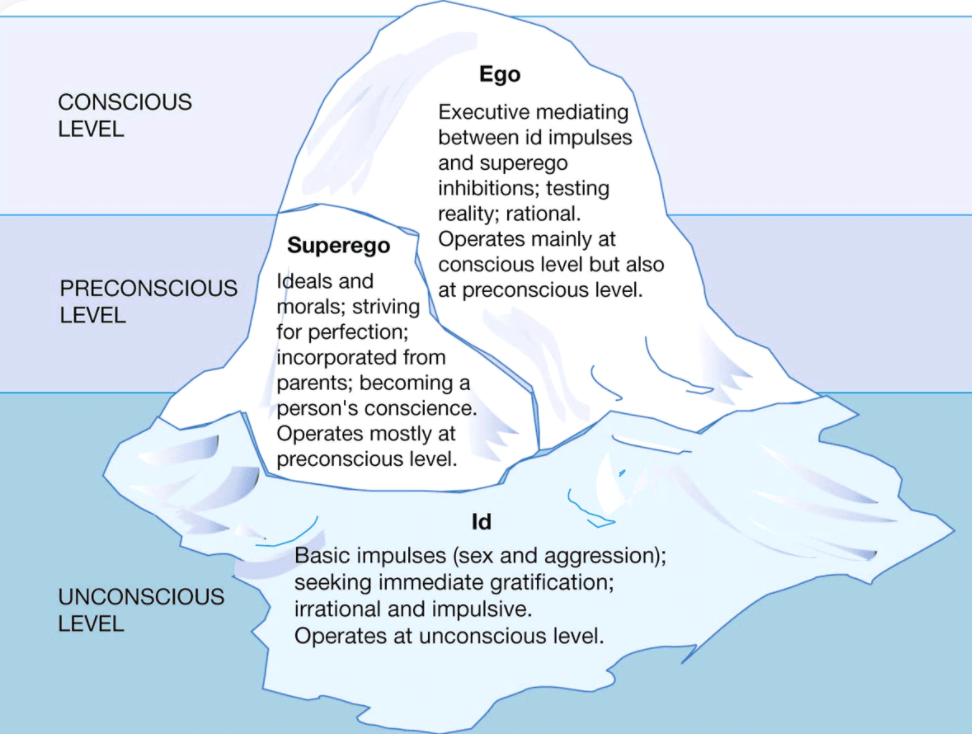
We have a natural tendency to be proud of our achievements and share our positive results with others. But when it comes to failure, we usually attribute it to the external factors: the system, the bank, the teacher, the school, the country, etc. It’s easier to find mistakes and blames others because of the Ego. Ego is a self-defense mechanism that prevents us from admitting mistakes. Freud’s personality theory (1923) saw the psyche structured into three parts (i.e., tripartite) the id, ego, and superego all developing at different stages in our lives. According to him ‘ego is that part of the ID which has been modified by the direct influence of the external world.’
ID, Ego and SuperEgo
The ego operates according to the reality principle, working out realistic ways of satisfying the ID’s demands, often compromising or postponing satisfaction to avoid negative consequences of society. The ego considers social realities and norms, etiquette, and rules in deciding how to behave. The ego has no concept of right or wrong. Often the ego is weak relative to the headstrong ID, and the best the ego can do is stay on, pointing the ID in the right direction and claiming some credit at the end as if the action were it’s own.
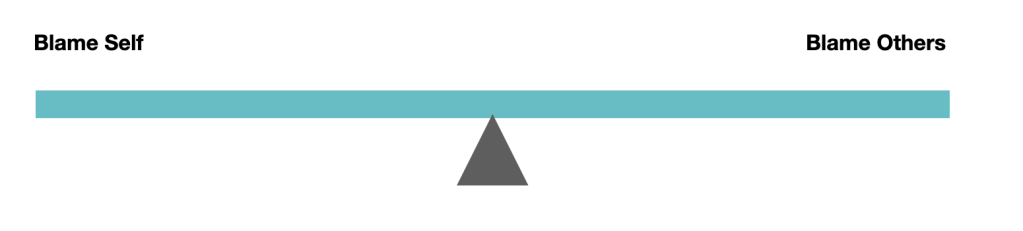
Freud’s theory of ID, Ego, and Superego its self is a separate topic in itself. So let’s focus on Blame which is part of the ego. If we plot the blame game in a scale then it is going to look like this
Blame Scale
On the extreme Blame side of our scale would be people who can always find something else to blame
At the other end of the spectrum are people who blame themselves for everything. There can be many reasons for this
He/she don’t want to confront with others, The self-esteem is low, The situations in their life would have made them like this and many more
There are even times we blame fate or a higher power, especially when there’s no one else who could conceivably have caused the outcome
To be in the middle of this scale and balanced life is not that easy.
Let’s have a look at ” Why we blame others”
It’s an excellent defensive mechanism
Blame is a tool for attack
When we are not good at finding the cause of other peoples behavior
Easier to blame someone else than accepting the responsibility
Why would we bother doing all that tricky self-analysis and taking steps to fix a situation if we can just take the blame off our own shoulders and place it down on someone or something else?
5. People lie
You may figure that no one will know it was really you who spilled coffee all over the break room, so you just blame someone else who’s not there (and hope that person never finds out).
6. To protect your ego
Now we know on a high level why people blame. What will happen when we actively engage in the Blame game
Your personal growth :
Your personal growth will be hindered, blame is a defense game, and the more you play this game it becomes a part of you. You will stop learning and will shut yourself in a cocoon.
You are actually not powerful:
If everything is everyone else fault then that means you don’t have the power to change that or you are not using your power wisely.
You will become less empathetic
If you blame to avoid the consequences or accountability, then you are not feeling for others. Which makes your relationships weaker.
Blame is contagious
If you blame people around you then they will blame you and others in the groups. This will lead to a team without any trust and you won’t be able to drive results.
Unlike other games, the more often you play the blame game, the more you lose. So before you start the game beware that you are going to enter a game that you will never win and will drain all your energy and personality out from you.
The only thing which you can control in this equation is what are you doing while you are growing up. Why are you doing that? Is that making you happy? You only have one life so we should make it count.
Finding that purpose requires balancing many things. You need to find that one thing which makes you happy. Our companies and leaders used to say we are sacrificing this for the greater good of the company, world, or country. I don’t disagree with doing what the world needs because it is important, but it should not be at the expense of your happiness. You might think of doing what you do best makes sense, but will anybody pay you for that. Because at the end of the day you need money to survive in the world.
This is when the Japanese principle of IKIGAI comes into play. IKIGAI means “Reason of Being”.This refers to having a direction or purpose in life.
IKIGAI
This principle can be used not just be individuals by also by the companies.
Before defining a catchy slogan, they should focus on finding the purpose and values. The companies with a strong sense of purpose and value will always perform better than their peers.
If you could align your Ikigai with those of the employees working with you, then that creates motivation and drive which eventually creates an environment with positive energy. People who are working in that environment will be driven to do their purpose and will be perfectly aligned with the company’s purpose.
The companies follow the same patterns as life ie. “Startup, Scaleup and Screwup” like “We Are Born, We Grow Up and We Die”. As a company, you should focus on postponing that inevitable. That is why it is important to find out the purpose, “the IKIGAI”. If that is found and served by generations of people the company can live for centuries.
Spend your time in finding the purpose of your company and your team. Your company’s vision/product vision will not count if it describes “the what and not the why”. This cannot be done by writing catchy phrases on posters.
Finding the IKIGAI is a lengthy process, So I suggest spending the time with your leadership team and team members. This should not be a one time exercise this should be done frequently so the purpose is served. The quickest way ( not the effective way) to start with is to print the prepared canvas of IKIGAI.
Give the smaller version to the individuals and stick the bigger version in the room. Ask every team member to write in their answers and post it in their small versions of the canvas. Keep in mind overthinking will over complicate. Hence don’t overthink and time box the activity to 5 to 7 to minutes per section. So that you could finish this in 30 minutes. After this map, it to the bigger canvas. When they map it to the bigger canvas ask them to explain it. This will help you in identifying the IKIGAI (purpose )of the company, team, and individuals.
We are Born, We Live and We Die. So choose wisely and make every moment count.
Once I was having a chat with my friends and we were joking about the digital transformation claims of different companies. One of my friends shared a story.
Two or three years back he joined a company ( A pretty big IT services Company) and there was one part in the induction program called “ The Digitalization Journey of the company”
My friend was eagerly looking forward to that session and surprisingly that ended up being the fastest session in the onboarding process.
The Digital Transformation Officer came for the session and opened up his slide
In fact, he had only two slides in his presentation (One heading and one content slide)
He said “ Hi guys Digitalization is a dream and buzz word for every company. It was the same for us. We were thinking about it for a long time!”
Then he showed the second slide which was a small video (2minute 30 sec) showing the employees using systems, Company infrastructure, and other digital platforms”
Then he concluded saying:
“One day we decided that we will become digital and then we became digital’
That is it! It was that easy.
What do you think?
If it was that easy then why many companies fail in digital initiatives or digitalization?
People Transformation:
The company is a group of different functions which is indeed is a group of different people. So when a company decides to change they need to change from the root. I.e. people and process.
This is one of the core reasons for the success of any digital transformation initiatives.
The majority of the companies which are trying for digital transformation were following the old factory model working of 8 hours per day with all the dirty hierarchy which you could ever imagine.
Hierarchy is like the “Apple which is given to Adam and Eve!”.
Its like Dope, once you get the kick of it people will chase behind that. During the journey will also make sure that their route to the top of the corporate ladder and the chain below is maintained. So they will always remain relevant and important in the organization.
This, in turn, will result in an approval process. As the hierarchy grows the time taken for any small approval will automatically increase.
I will tell you another story about a friend of mine.
He joined as Chief Digital Transformation Officer in a company. For some initiative, he needed two white tables and four chairs in the big room near to the warehouse.
He called up the office boy and asked him:” Could you please arrange this in the room we have a meeting at this time.”
The next day he thought of checking the room but, the tables and chairs were not there.
He called up the office boy again:
“What happened, where are the tables and chairs?”
Office boy replied “ Sir, you have to send a mail to the Facilities Manager and he needs to approve that, then only I can provide”
He straight away sent the mail to the “ Facilities Manager “
There was no reply from this guy for two days. So he decided to pop into his big cabin.
He introduced himself and mentioned about the mail he sent.
The facilities manager replied: “ Who are you?”
He explained he is so and so and his role.
Facilities manager “ But Who are you to send that mail to me,? When you join a company you need to first learn the hierarchy, I don’t report to you. We have a process for doing everything here. As per the process you have to send the request to the CEO because you are reporting to the CEO. Then send me that approval mail”
He continued: “Our SLA is 2 days after that approval. So no use of popping into my room.”
I consider this as a classic example of the bad effects of hierarchy.
So the first thing to change is the Hierarchy and Mindset of people
Process
When you closely observe any process you will realize that majority of them are just a CYA ( Cover Your Ass) strategy.
Hierarchy creates insecurity and politics which will result in loss of trust among colleagues and departments.
So change the CYA process to ESW (Expose strength and weakness ) process.
Companies should start considering people as there core assets ( many are saying this in papers and presentations, But what I mean is “from the heart”).
Richard Branson once said: “ Clients don’t come first. Employees do. If you take care of your employees, they will take care of the clients. “
This plus ESW is the key mantra for digital transformation.
People will be honest only if they trust the person next to him. You will open up only if you trust someone. No one will figure out your strengths or weakness till you open up
Once your college knows your strength and weakness then it’s easy to share the work and support each other.
So second is build up this culture ( we need a separate write up to explain further on this)
Rewards and Recognition:
Getaway with rewards and recognition. There is no point in awarding the best performer because we work as a team and the team is as fast as your slowest member.
So the role of everyone is to support each other and bring everyone to the same speed. When you start recognizing one person you are actually hurting 90% of others (because we are humans we have egos and others will start finding ways in that cooperate ladder).
This is the reason why many Agile organizations are finding it easy to do Digital transformation.
But what the hell is this Digital Transformation! ?
“It’s the Integration of Digital technologies into all areas of business which will result in changing how you operate and deliver value to customers. This start with cultural, status quo change sand getting comfortable with failures”
We briefly touched upon the people’s change. Now I want to briefly touch upon the failures.
Failure
What’s the acceptance rate of Failure in a Hierarchy driven traditional company?
Every failure will be marked in the yearly review and will be cross-questioned during the appraisal meetings and you can even fall in PIP ( Performance Improvement Plan) because of failure.
PIP is another funny process. “ It’s as if like we are machine just tune the engine and it will perform better.”
Oh please!!, Please learn to consider your employees are humans.
Because of this every individual and every department fears failure. We have to break this dirty chain.
We are humans and we are bound to make mistakes. Human nature is to make mistakes and learn from mistakes. That is how we learned to walk, eat, talk, etc and it’s going to be the same for Work.
So we have to accept failure, but make sure you are failing fast and learning fast. Once we start accepting failures people will be more willing to take up new initiatives and this will result in new ideas, new products, new ways of doing business, etc.
According to the Digital Transformation Officer in my friend’s company, it was so easy to transform the company:
“One day they decided that they will become digital and then they became digital “,
Realistically this won’t work.
I am not saying these alone will make you digital. There are other reasons like silent disagreements in the management layer, failing to take the iterative approach, belief that buying a platform will transform, and many others. But the ones I mentioned above are some of the basic things to start with. It’s a long journey that will force you to change many of your behaviors, process, systems, also embark and respond to changes quickly.
If you really want to transform, then be brave and be ready for the change.
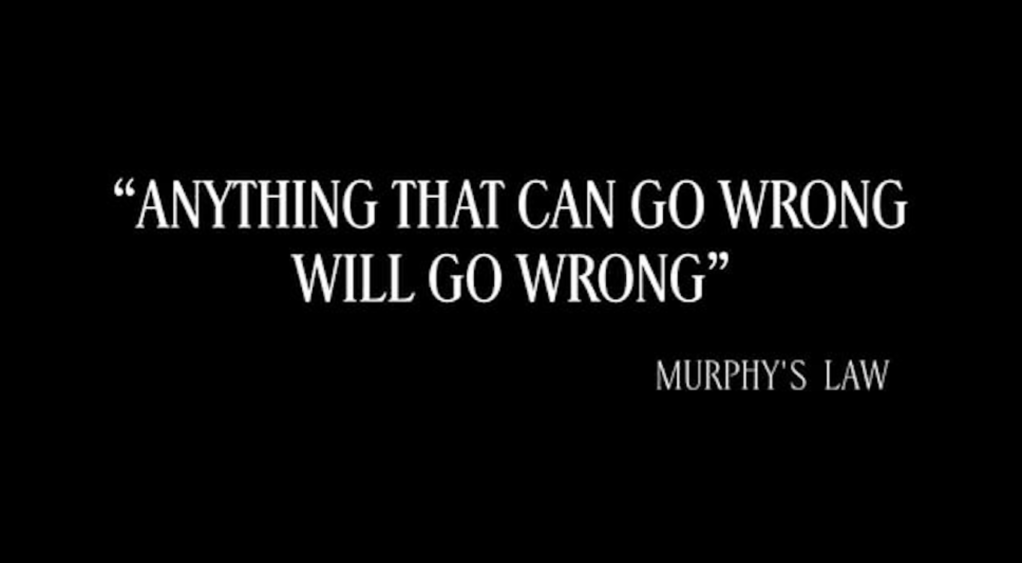
There are more ways things can go wrong than right.
Imagine you are placing a deck of cards inside a box. Then you started shaking the box. It’s possible that the deck of card is reassembled in the same order after that vigorous shaking. But in reality, that never happens. Why? Because the odds are overwhelmingly against it. There is only one possible state where every piece is in order, but there are a nearly infinite number of states where the pieces are in disorder. An orderly rearrangement is incredibly unlikely to happen at random.
The difficulties of life do not occur because the planets are misaligned or because some cosmic force is conspiring against you. It is simply entropy at work. It is nobody’s fault that life has problems. It is simply a law of probability. There are many disordered states and few ordered ones. Given the odds against us, what is remarkable is not that life has problems, but that we can solve them
You can fight back against the pull of entropy. You can solve a scattered puzzle. You can pull the weeds out of your garden. You can clean a messy room. You can organize individuals into a cohesive team.
When you are in a mission to change things always keep in mind that, changing your/people’s minds are harder than it looks. The more you believe you know something, the more you filter and ignore all information to the contrary.
The moment you start sharing new ideas, information, your knowledge etc. People will start thinking and searching google for what they believe. Our tendency to search for and favor information that confirms our beliefs while simultaneously ignoring or devaluing information that contradicts our beliefs.
This is why I started with Murphy’s law. When you plan something the probability of the things that can go wrong is always higher. For making any change you have to expend energy to create stability, structure, and simplicity. Successful relationships require care and attention. Successful houses require cleaning and maintenance. Successful teams require communication and collaboration. Without effort, things will decay.
It’s not easy to change the way people think, but that doesn’t mean that you should not try. We should and it is not going to be easy.
There will be another set of people the “know all types”. When you are driving a change, you should not waste your effort to convince these group. They will neither accept nor reject the change. These groups are like magnets of -ve energy. The more you fight against them, the more they attract -ve energy. So be focused on your views, these types will eventually die after the period of chaos.
Given the odds against us, what is remarkable is not that life has problems, but that we can solve them all.
Take the case of that box and deck of cards. If you add more cards to that box or increase the size of that box, it will result in more chaos.
Chaos is an after effect of entropy and entropy accelerates Chaos. The way to control chaos is to set examples. What this will do is people will start looking at that and the entropy effect will slowly come down and the chaos can be managed. Look at history, a leader emerges from every chaotic situation and people started following that leader. Eventually, the chaos would have ended or slowed down.
In chaos :
Try to always find something good to point out and something positive to contribute.
Lead by example and set a standard in light of unreasonable expectations.
In Chaos, leaders and people will be quick to point out mistakes and shortcomings. Counteract it by acknowledging your own work and bringing attention to your (and your teammates’) contributions
Learn to keep speaking up and speaking out, and find solutions to every “but,” one at a time.
When you know where your boundaries lie, you know when you have to speak up — or even walk.
Rise above the dysfunction of existing leadership and be an example of the leadership that can work.
Above all, don’t allow yourself to believe that it’s an acceptable way to live or lead.
“Let things go wrong, but you should keep doing the right thing. It will slow down entropy”. More than anything this defines a character, a solid powerful character in you.










 Trooming