
Humans Need Stories to Work Together: The Power of Storytelling

Photo by Ugur Akdemir on Unsplash

One key factor differentiating humans from other animals is that we can work together in big groups. Yes, some animals can work together in groups like wolves or chimpanzees but in a maximum size of 50 or 100. But we are not like them, we can work together in groups of millions or billions. Yes, you read it right “millions or billions”

Take the case of religions, millions of people march towards achieving their spiritual principles even though they don’t know each other, people from different parts of the world, from different ethnicities, cultures, values etc. Have you ever wondered how and why this is possible?

That is the power of storytelling. Take the case of religion. Take any religion in the world they all are collections of powerful stories that connect directly to our emotions. Stories that paint a bigger picture or cause, a cause for your existence, a role that you have to play, or an inspiration from a character from the many stories those books have.

All of those stories have conflicts, resolutions, relatable characters, motivations, and emotions, that create a sense of belonging and community. This is the reason why people who haven’t seen each other rally behind these religions.

You might be wondering where am I going with this. The reason why I thought about this is because of this project incident.

My friend has been working on this team for the last 10 to 12 years. A team that was delivering consistently for these years but suddenly things have changed and now everything is stuck,and things are not moving.

What happened was:

This dev team was part of one of the biggest companies in the world. The dev and business team used to be under the same company until one day they found that they wanted to increase the profitability, and their numbers were not going in the positive direction according to the competition in the market.

The C suites sat together and looked at the numbers and they pulled out the most powerful tool they had. “ The Excel sheet”. They started playing around with the numbers and found out that if they could reduce the dev cost then the numbers could match up to the figure they wanted.

This was the eureka moment for them.“ Sell or outsource the dev work” !

They formed a separate unit inside the company whose responsibility is to make the parent company profitable. By either selling, handing over, or outsourcing the development team. Effectively they made their problems someone else’s. Simple!

So what happened at the end was the dev team who had been working on this project for many years was suddenly bought over by another big service company in the world. During this process, some of them lost their jobs. The new service company outsourced those roles to save money and the remaining was being absorbed under their banner. A story that looks perfect in paper. The numbers became positive and happy ending for the C suites, They achieved the target.

But the same people who were super productive earlier are not effective now. Projects are not getting delivered, systems are failing one after the other, escalation emails are flying right left-center, nothing is happening and the team doesn’t care. Why?

This made me wonder why the same set of people is not able to resolve these issues or not care about what is happening now.

The reason is, they lack belonging, they lack purpose, and they feel cheated. Now there is no story that connects them to the new flag that’s being flying above their heads. This is similar to the feeling of the people who are being conquered by another empire.

Almost with every merger and project pressure, most of the corporates miss this part. The power and effectiveness of storytelling. You have to realize at the end of the day every project in every company is a group of individuals, they need a common belief, a role which they all have to play towards a bigger story, and the leaders have to articulate that story and stay true to that narrative.

People seek purpose in life. If work lacks meaning or purpose, they will leave despite friendships. To retain employees, ensure the company’s mission resonates personally with them.

This incident ignited a spark in me about “why people collaborate”? What I realized is, that for us to work together we need a shared story or goal and one of the most impressive thing about storytelling is the ability to communicate and create feelings.

When you come up with stories, remember that storytelling starts with your audience and not with the story. For this, you must know your audience and empathize with them. Otherwise, you will be like that uncle who repeats the same story repeatedly. Not just that, you should keep your words and actions in sync so more and more people will start believing in your story and will start following you. Thus creating strong lasting teams.

Also, keep in mind that it is not just a number game at the end of the day. 

I would like to know your opinion about the power of storytelling and team building. Please feel free to share your comments below. 

The content is also available on my channel: https://youtu.be/Ke8jjejPG30

The Flow State

Photo by Priscilla Du Preez 🇨🇦 on Unsplash

We all have this problem of getting bored. I am the one who gets bored when doing the same things again and again. When I sense boredom I try to find something which is interesting. What I have noticed (at least for me ) I can distract myself for only a certain period after that the boredom just consumes me fully.

I started talking with people who are in the same boat and realized almost all of them are in the same category. If they get bored they will try to distract and eventually, they will be consumed by that fully. Since they realize this most of them quit early before it hits them and some look for distractions and eventually get consumed by boredom.

During one of those boring days, I was retrospectively looking at the period where I was bored Vs the period I was super productive. That is when I started realizing that we are more productive when we are in the “State of Flow”.

Mihaly Csikszentmihalyi is one of the founders of positive psychology and was one of the first to identify and research about “ The Flow State”. He once said

“The best moments in our lives are not the passive, receptive, relaxing times . . . The best moments usually occur if a person’s body or mind is stretched to its limits in a voluntary effort to accomplish something difficult and worthwhile”

If you think of a time when your performance excelled and we call in the zone where we were ready to take up any challenge. That is the state of flow. Flow occurs when your skill levels and challenges match.

According to Mihaly Csikszentmihalyi below are the 8 characteristics of flow

  1. Complete concentration on the task
  2. Clarity of goals and rewards in mind and immediate feedback
  3. Transformation of time (speeding up/slowing down)
  4. The experience is intrinsically rewarding
  5. Effortlessness and ease
  6. There is a balance between challenge and skills
  7. Actions and awareness are merged, losing self-conscious rumination
  8. There is a feeling of control over the task

So the question is who can achieve this state of Flow? Studies suggest that autotelic personalities(having an end or purpose in itself) tend to achieve this faster. They tend to do things for their own sake rather than chase something.

The personality traits of this group (autotelic) are: they have high interest in life, persistence, and low self-centeredness.

We also need to understand what happens in our Brain during Flow

During the state of flow, the prefrontal part of the brain will get temporarily inactivated. This part of the brain is responsible for self-consciousness, memory, temporal integration, and working memory. This temporary inactivation results in feelings of distortion of time, loss of self-consciousness, and loss of inner criticism. This also allows our brain areas to communicate freely and engage in a creative process. You might have felt this while playing sports, games, reading, solving puzzles, etc.

How to achieve the state of Flow:

The balance of perceived challenges and skills are important factors in flow. On one hand, when a challenge is bigger than one’s level of skills, one becomes anxious and stressed. On the other hand, when the level of skill exceeds the size of the challenge, one becomes bored and distracted.

Flow State

Studies suggest that the state of flow is enjoyable when you flow together as a team. For a team to be in the flow state we need motivation. There are two types of motivation Intrinsic and Extrinsic.

Intrinsic motivation is when you do something because you love it. Mihaly Csikszentmihalyi said “The highest intrinsic motivation is a flow state where self-consciousness is lost, one surrenders completely to the moment, and time means nothing

Extrinsic motivation is when your motivation to succeed is controlled externally. That includes doing something to avoid getting into trouble or working hard to earn more money. That type of motivation is short-lived. A good kind of extrinsic motivation is when you are practicing to get better but you still need a tutor or teacher to validate your efforts.

Difference between Team & Group

A team is a small number of people with complementary skills who are working towards achieving common goals. A team is dependent on one another while holding each other accountable so they can accomplish their goals. Whereas a group is mostly independent members focusing or working on there piece of tasks.

How to lead your team toward Flow state?

For the team to be in a flow state every individual must be in the flow state. This occurs when team members can immerse together in an interdependent task that all the members are satisfied with. When your team achieves Flow state they can create greater results than the individual contributions. Some key points to achieve a flow state are:

  1. Set clear and immediate goals at every stage
  2. Receive clear and immediate feedback
  3. No agony over failure
  4. Have a balance of skill & challenges
  5. Have control over the situation and have no fear of failure
  6. Create intense and focused concentration
  7. Ensure the work itself is intrinsically rewarding
  8. Clear communication both verbal and non-verbal
  9. The process is what’s enjoyable, not the result

Effects of Flow:

Flow is often explained as a positive experience. It’s not just improving productivity but also the group’s happiness and positivity. Consistently being in the state of flow could lead to a state of stress, because once in flow, unknowingly a person easily gives everything of their capacity.

It is therefore important to know how to ‘get out’ of the flow or take a break from it. Teams, Leads, and Individuals have to understand and learn the fact that “ promises cannot be always kept and that is natural and it’s not poor planning or intentional

It is also good to understand that breaks from flow are important and natural; otherwise, they may appear sticky or even depressing periods after the joy and successful performances created by flow.

Studies found that flow experience is better when experienced together.

I would like to know if your team ever worked in flow. What did you notice? What were the results?

https://bivekrenuji.medium.com/the-flow-state-b2fe22ae938f

Achievement, Affiliation and Power

Managing a group of people with different personalities is never easy. But when you are

Managing a team it’s essential to know what motivates the people, how they react to positive or negative feedbacks?.

Regardless of age, culture or gender, there are only three motivating factors

  1. Achievement 
  2. Affiliation
  3. Power

If you understand the three factors then you can classify the team into these buckets and then approach them based on what they need.

Achievement, Affiliation, and Power

Achievement :

It’s the urge to achieve something. People who possess high achievements are the ones who always want to excel in their fields. They tend to avoid low risk and low rewarding things and focus on high risk high rewarding things.

They avoid low-risk things because of the lack of challenge and they don’t get the real feeling of achievement in this.

These people find innovative clever ways to achieve goals and consider their achievement a better reward than financial ones. Their preference is to work in a results-oriented work environment and always appreciate any feedback on their work. Achievement based individuals take calculated risks to reach their goals and may circumvent both high-risk and low-risk situations.

This group will have two types of people those who only prefer to work alone and the others who are great team players and can drive the team together with them.

Affiliation :

It’s the urge of a person to have the social and interpersonal skills. These people like to work collaboratively and they tend to avoid high risk situations and they get nervous with uncertainties.

These individuals socialize, maintain relationships, etc. They also tend to play by the books and will tend to continue a step process. They also fear changing the process because of the fear of failure.

They feel collaboration is the way to go and they follow the workplace rules and they don’t change the norms because of the fear of rejection.

These groups of people are good in customer interactions, Client services, stakeholder management, etc. They tend to find a comfort zone and will not tend to break that comfort zone.

Power:

Is the desire within a person to Control, authority over another, influence, and change the decisions of others. For these groups of people, power is the motivation factor.

Competition motivates them because they enjoy winning arguments ( they will be motivated as long as they win the argument 🙂 )

Status, Recognitions, Position, etc motivates them. If not carefully handled these groups of people tend to become micromanagers. As these groups are motivated by power and position they tend to ignore the knowledge which they have to gain over a period of time. So it’s important to keep a check on the learning part.

As a leader, your role is to identify the personality types and handle the members according to what they need. This will help you in identifying the personality type and you will know what can be used in favor of the team and what can go wrong.

Sounds so simple, but if you look at the diagram the intersection between these personality types is going to make things tricky and complicated.

View at Medium.com

Blame: The Game that Goes on

We have a natural tendency to be proud of our achievements and share our positive results with others. But when it comes to failure, we usually attribute it to the external factors: the system, the bank, the teacher, the school, the country, etc.
It’s easier to find mistakes and blames others because of the Ego. Ego is a self-defense mechanism that prevents us from admitting mistakes.
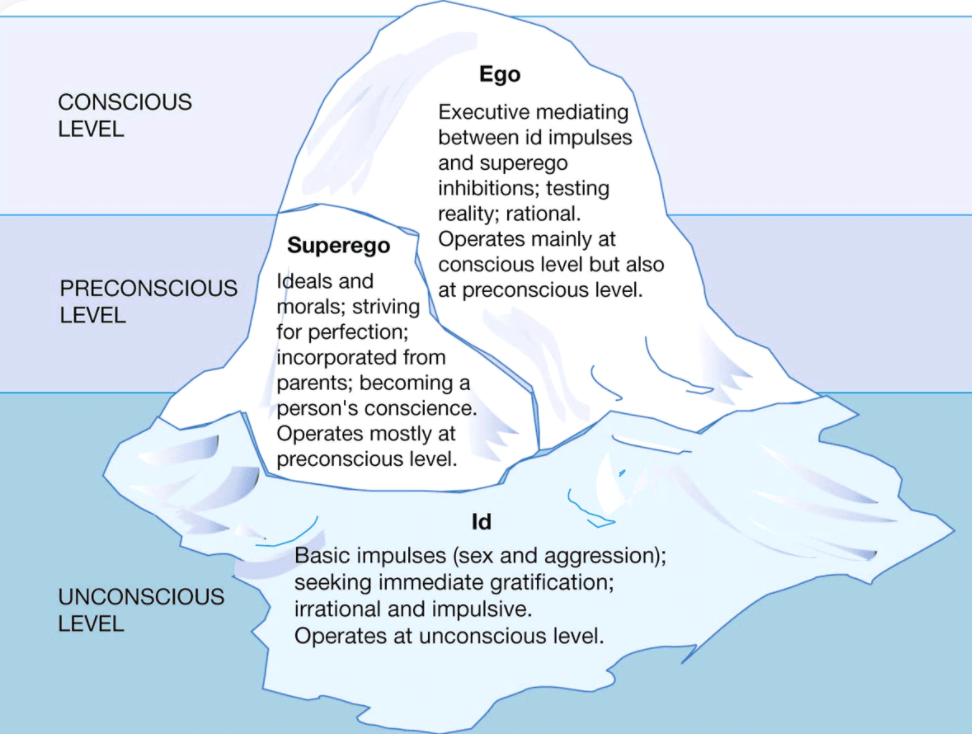
Freud’s personality theory (1923) saw the psyche structured into three parts (i.e., tripartite) the id, ego, and superego all developing at different stages in our lives.
According to him ‘ego is that part of the ID which has been modified by the direct influence of the external world.’

CONSCIOUS 
LEVEL 
PRECONSCIOUS 
LEVEL 
Executive mediating 
between id impulses 
and superego 
inhibitions; testing 
reality; rational. 
Superego Operates mainly at 
conscious level but also 
Ideals and 
at preconscious level. 
morals; striving 
for perfection; 
incorporated from 
parents; becoming a 
person's conscience. 
Operates mostly at 
preconscious level. 
Basic impulses (sex and aggression); 
seeking immediate gratification; 
UNCONSCIOUS 
irrational and impulsive. 
LEVEL 
Operates at unconscious level.
ID, Ego and SuperEgo

The ego operates according to the reality principle, working out realistic ways of satisfying the ID’s demands, often compromising or postponing satisfaction to avoid negative consequences of society.
The ego considers social realities and norms, etiquette, and rules in deciding how to behave.
The ego has no concept of right or wrong. Often the ego is weak relative to the headstrong ID, and the best the ego can do is stay on, pointing the ID in the right direction and claiming some credit at the end as if the action were it’s own.

Freud’s theory of ID, Ego, and Superego its self is a separate topic in itself. So let’s focus on Blame which is part of the ego.
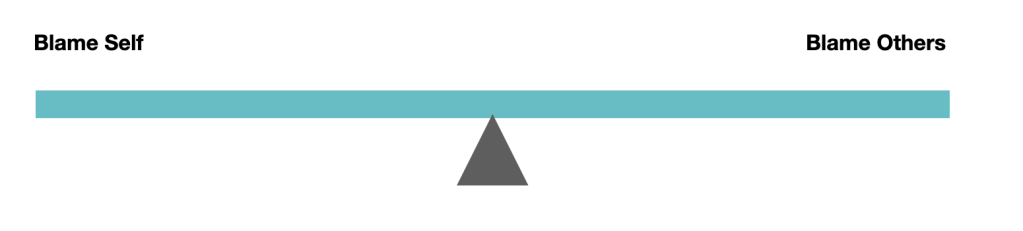
If we plot the blame game in a scale then it is going to look like this

Blame Scale

On the extreme Blame side of our scale would be people who can always find something else to blame

At the other end of the spectrum are people who blame themselves for everything. There can be many reasons for this

He/she don’t want to confront with others, The self-esteem is low, The situations in their life would have made them like this and many more

There are even times we blame fate or a higher power, especially when there’s no one else who could conceivably have caused the outcome

To be in the middle of this scale and balanced life is not that easy.

Let’s have a look at ” Why we blame others”

  1. It’s an excellent defensive mechanism
  2. Blame is a tool for attack
  3. When we are not good at finding the cause of other peoples behavior
  4. Easier to blame someone else than accepting the responsibility

Why would we bother doing all that tricky self-analysis and taking steps to fix a situation if we can just take the blame off our own shoulders and place it down on someone or something else?

5. People lie

You may figure that no one will know it was really you who spilled coffee all over the break room, so you just blame someone else who’s not there (and hope that person never finds out).

6. To protect your ego

Now we know on a high level why people blame. What will happen when we actively engage in the Blame game

Your personal growth :

Your personal growth will be hindered, blame is a defense game, and the more you play this game it becomes a part of you. You will stop learning and will shut yourself in a cocoon.

You are actually not powerful:

If everything is everyone else fault then that means you don’t have the power to change that or you are not using your power wisely.

You will become less empathetic

If you blame to avoid the consequences or accountability, then you are not feeling for others. Which makes your relationships weaker.

Blame is contagious

If you blame people around you then they will blame you and others in the groups. This will lead to a team without any trust and you won’t be able to drive results.

Unlike other games, the more often you play the blame game, the more you lose. So before you start the game beware that you are going to enter a game that you will never win and will drain all your energy and personality out from you.

View at Medium.com