What is Culture? & A Silent Casualty in the Agentic Era.

Culture, a word we are so proud of. 

Every society and every company is proud of its culture and believes that it is the epitome. Like, some companies with truly questionable cultures also claim they are the epitome of culture.

Have you ever wondered what this culture is and how it forms and shapes?

The most famous definition of culture is by the English anthropologist Edward Burnett Tylor.

“Culture is a complex whole encompassing knowledge, beliefs, art, morals, laws, customs, and other capabilities and habits acquired by individuals as members of society.”

If you examine the cultures, this is something that is unique to humans; no other animals possess this. Rest, all animals have behavioural traits and not cultural traits.

That is one non-debatable topic that only humans possess culture. With the GenAI and humanoid robotic era non-humans are going to enter our workspace or already are in our workspace.

How are businesses and companies that are so proud of their culture going to handle this? How are you going to teach your company culture to GenAI?

Let’s look at the layers of culture:
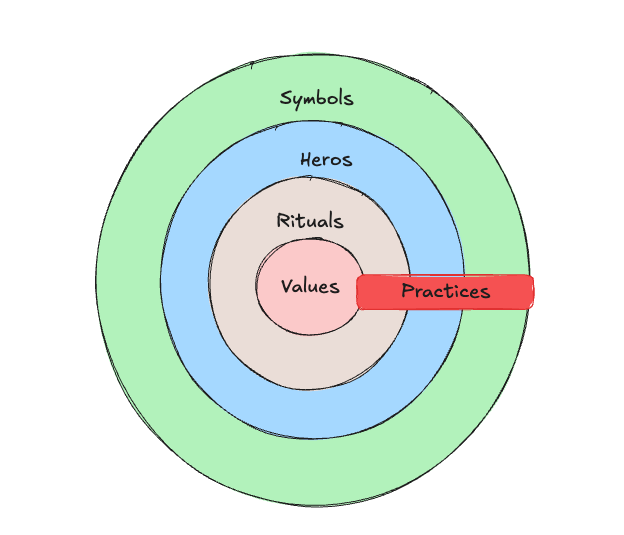
Layers of Culture

Symbols

The outer layer of culture is Symbols: These are words, gestures, objects, pictures, etc. that carry a particular meaning.

Your company logo is one among them; the way you treat the people, how you communicate those, etc, defines the symbols in your company.

Heros

There are real or fictional persons, in the past or present, who stood for the group or company. They serve as the model behavior.

This could be anyone in our company who stood and fought for the values of your company. You need a heroic story of a group of people or a person, or a project that you can quote and remind people that this is how we used to do this and this is how we will continue evolving. This will be passed on to the generations to come, and that will help cement the culture.

Rituals

These are collective activities; these are social necessities. Sometimes these are not necessary in reaching the objective. Like ways of greeting, showing respect, ceremonies etc.

In your company, this could be your stand-ups, town halls, how you greet each other, how you conduct meetings, when, and how.

Values

This is the core of every culture. These are states of affairs that define Good & Bad, Right & Wrong,etc. Values can only be inferred from the way people act under different circumstances.

If you look at the diagram, culture is like the layers of an onion. When you start peeling away the layers in search of the “real” onion, you won’t find it — because those layers are the onion.

In the same way, without all of these layers, there is no culture.

The visible aspects of culture are its symbols, heroes, and rituals, and these are the elements we can see, hear, or observe in everyday practice. The real meaning behind these things is connected to values, beliefs, and practices. This drives emotions, and this is invisible and intangible.

In the world of Agents, Humanoid robots, and GenAI, it will be difficult to create these emotions. So how are you going to create a culture, or how are you going to keep your culture intact? 

As we discussed earlier, culture is something that is possessed and followed by only humans. In the new world, the leaders of the companies are going to play a more important role than before in determining and making sure the company is staying true to the culture.

Some of the changes that are going to happen are:

1. Companies don’t need a big team

This is a sad truth for some, but the reality is we don’t need big teams to deliver a project anymore. Fewer people to manage, fewer meetings to survive… project managers might actually be smiling at this one 🙂 .

This means that your heroes or heroic stories of projects have to come from this small group. The leaders in these projects have to stay true to the company culture.

2. More Agents:

Agents will be deployed not just on the dev side but also in all aspects of business, from customer service to reporting to operations, to content, and to almost every aspect of business.

You need to inject the symbols and values into these agents. You should be tuning and training your customer service agent to keep the tone of voice the same as the brand does. The content agent should be generating the content, keeping the brand values in place. The operational agent should control the operations, keeping the process, tone, and methods aligned to the brand’s values and cultures.

If you just roll out an agent without defining and fine-tuning this, then its going to kill your culture.

In order to make sure this is in place, you might have to write Evals, track them, and optimize them continuously.

3. Resources in Payrol Vs Resource on Demand

I believe that as agents continue to evolve and mature, companies will start relying on fewer full-time employees. Instead, they’ll increasingly onboard talent on a project or product basis, releasing them once the work is complete. Much of the work previously handled by these roles will soon be automated by intelligent agents. As a result, organizations will view this shift as an opportunity to significantly reduce operational costs.

From a cultural perspective, this shift poses a potential threat. As people join from different backgrounds, collaborate for short engagements, and then move on, maintaining a consistent culture becomes challenging. Therefore, clearly defining and reinforcing your company’s practices and rituals in every project will be crucial.

However, these practices shouldn’t feel rigid or imposed — they should naturally integrate into the way of working within each project. If you fail to define them, individuals from diverse environments will bring their own ways of working, and over time, your organization may lose its unique identity and culture.

3. Mini-Culture for every project

Since every project is going to onboard different people at different points of time. You need to have a mini culture that fits the delivery. This should be a subset of your company culture that is consistent in values but flexible in execution.

For example, if your company defines a development process, it shouldn’t be overly rigid. The process should outline what needs to be done, not dictate how it must be done.

Think of it like:

Instead of saying, “You must eat three meals a day — breakfast, lunch, and dinner — and breakfast must be a three-course meal with specific dishes,” you simply set the expectation that “You must have three healthy meals a day.”

This allows individuals the freedom to choose what and how they eat, based on their context and availability, while still aligning with the core intent of staying healthy.

Now, bringing this back to your project, defining a process like this helps ensure that every team carries out a code review. But the format and who conducts it can change based on the systems, platforms, and technologies involved.

How can you preserve your culture?

All the best!

(Not joking — it’s not going to be easy, especially for those self-proclaimed “great culture” champions.) The real test begins now.

Your leaders and senior folks will have to step up and play a truly crucial role. Maybe take another look at that onion diagram and honestly reflect on what needs to change — the how and the why.

I believe this is something that we have to carefully consider, even when we are racing to keep up the pace. What do you think?

Where Are The Real People?

These days, we connect with friends, family, and colleagues through digital media. We are proud that we are always connected and and these days, there are countless ways to stay connected. We are proud of adding more and more connections to our network. In the world of social media, we are getting addicted to follows, likes, feelings in the shape of the heart & different icons, the count of connections, etc.

But somewhere, somehow, we forget where the real people are. Are we even connected to them? Or how many genuine connections, friends, follows, hearts, or many of those emojis do we own?

This begs the question: Where are the real people? This sets me into a quest to understand who they are, where they might be, and why do they seem so hard to find and I’m willing to bet you’ve had moments too — times when you’ve wondered the same, faced situations that made you question what’s real and who’s truly genuine.

To the world, you are what you appear — But only a few glimpse who you truly are

Have you ever looked at someone in a position of power and thought, “How on earth did they get there?” We’ve all witnessed it. People who seem thoroughly incompetent are rising to positions of authority while more capable individuals remain stuck in the shadows. Why is this happening? First, I thought this was something that started happening recently. Then I stumbled upon the studies of “Niccolo Machiavelli,” an author, philosopher, and historian who lived during the Italian Renaissance. He is best known for his political treatise The Prince, written around 1513 but not published until 1532, five years after his death.

That book is not merely an ancient philosophy — it’s a real psychological force and mindset that shapes our world from boardrooms to politics.

Unlike the other philosophers, Machiavelli wasn’t concerned with how rulers should behave in a perfect world. Instead, he focused on how power actually worked in the real world. He understood that perception always matters, and that is the way to control the crowd. “To the world, you are what you appear — But only a few glimpse who you truly are.” This is the key.

“Appearing competent is often more important than actually being competent”.

Machiavelli observed that rulers who display too much intelligence often create problems for themselves. Because intelligence usually comes with certain traits that can become liabilities. Traits like critical thinking, ethical considerations, and self-awareness.

Imagine what happens when a genuinely intelligent person enters a power structure. They tend to see complexities where others see simplicity, they point out limitations where others make blanket promises, they question themselves and the choices we make, whereas others project absolute confidence in everything they say or do.

This is where you might notice that the loudest voice that simplifies situations becomes most influential. Why is this happening?

In the 1990s, psychologists David Dunning and Justin Kruger identified what we now know as the Dunning-Kruger effect, the cognitive bias 

The people with limited knowledge in a particular domain overestimate their ability /competence, while genuine experts tend to underestimate their awareness of how much they don’t know !

Like Socrates used to say, “I know that I know nothing,” this made him a philosophical genius, but ultimately sentenced him to death by the Athenian democracy.

You could see this in politics and in the tech industry. The politician who claims to have solutions to everything and the founders who speak in absolute visionary terms often secure massive funding and support over more measured, experienced counterparts. 

The self-proclaimed leaders, Me Me Culture or Narcissism

Narcissism and non-competence are the strongest predictors of who emerges as a leader in unstructured groups. This is not my statement, it is from 2012 researchers at Stanford and the University of Houston. They found that the groups that were led by these narcissists didn’t win; they just thought they were winning.

The confidence signals and cognitive bias help these incompetent individuals initially rise to power.

Machiavelli observed something crucial about power structures: incompetent leaders tend to surround themselves with even less competent subordinates. In “The Prince,” Machiavelli wrote, “The first method for estimating the intelligence of a ruler is to look at the men he has around him.” The weak leaders deliberately select weaker subordinates to ensure they never face threats to their authority. You might have observed the same around you in politics, in corporations, organizations etc.

Reality Vs Certainty

When dealing with real-world problems, uncertainty is real, and that is the reality. We can’t predict what exactly will happen. But according to human psychology, we crave certainty even when certainty isn’t possible. Because of the same reason, when in crisis, either a political crisis or a project crisis, people rally behind the leader who says, ‘I can fix this, and I alone can fix this’. But the reality is that the complex situations with no easy answers will require careful thought and inevitable trade-offs instead of self-proclamations. You might have seen incompetent people rise to power and fall flat on their faces. The world has seen this during the COVID-19 pandemic. 

The political figures and leaders who offer simplistic solutions and promise everything with no downsides will win public support. Those who offer everything with certainty, regardless of feasibility, are jarring.

These days, these kinds of leaders and solution providers are everywhere you can see them in politics, in corporations, on social media, and LinkedIn is no exception.

Fake personas all over.

University of British Columbia researchers found that psychopathic traits like, lack of empathy, were positively associated with rapid advancement when combined with social charm.

Studies conducted in corporate offices show that “manipulative leaders often outpace their intelligent, moral, ethical peers”. Game theorists call this “A race to the bottom, when unethical tactics prove successful, others face pressure to adopt similar approaches or be left behind over time. This can transform entire systems, making unethical behavior the norm rather than the exception. This is a serious issue — we are normalizing extreme thinking & intolerance, which in turn fuels sociocultural conflicts and violence. This trend can be observed across nearly every country around the world.

You might have even noticed a version of this on LinkedIn. In the initial days, those who created a persona of an expert on LinkedIn started landing jobs. Fast forward to now, LinkedIn is full of experts, and it’s difficult to find the real ones.

Machiavelli recognized that most people evaluate others based on surface impressions rather than deep understanding, especially in complex domains where few have the expertise to make informed judgments. He said, “Systems that reward short-term performance over long-term outcomes create fertile ground for incompetent leadership with superficial charm.

Machiavelli has been misunderstood for centuries. He wasn’t advocating for the dark patterns instead, he was describing and exposing them by understanding how power actually works. He believed we could create better systems of governance if it’s not titles that honor men, but men that honor titles. This profound observation reminds us that authority itself deserves no inherent respect. Power must be earned through worthy use, regardless of who holds it.

The intersection of Machiavellian political philosophy and modern psychology reveals uncomfortable truths about human nature and social systems. The uncomfortable truths are precisely what we need, if we hope to create a better future. The path forward isn’t pretending these dynamics don’t exist; it’s understanding them deeply enough to transcend them. It’s designing systems that account for human vulnerabilities rather than exploiting them. It’s developing personal practices that strengthen our resistance to manipulations. Most importantly, 

It’s recognizing that while stupidity may sometimes gain power, intelligence coupled with moral courage remains our best hope for creating societies where merit truly matters.”

Reference materials:

The prince by Niccolo Machiavelli

Dunning-Kruger effect by the psychologists David Dunning and Justin Kruger

Research materials from Stanford and the University of Houston

Research about psychopathic traits in humans from various research materials and universities like the University of British Columbia, and other psychology papers

Surface scratching basics about Game Theory

Impact of Cognitive Bias on people and decision making 

Many YouTube videos on these research papers 

A digital takeaway from “The Nike Story”

Photo by Goh Rhy Yan on Unsplash

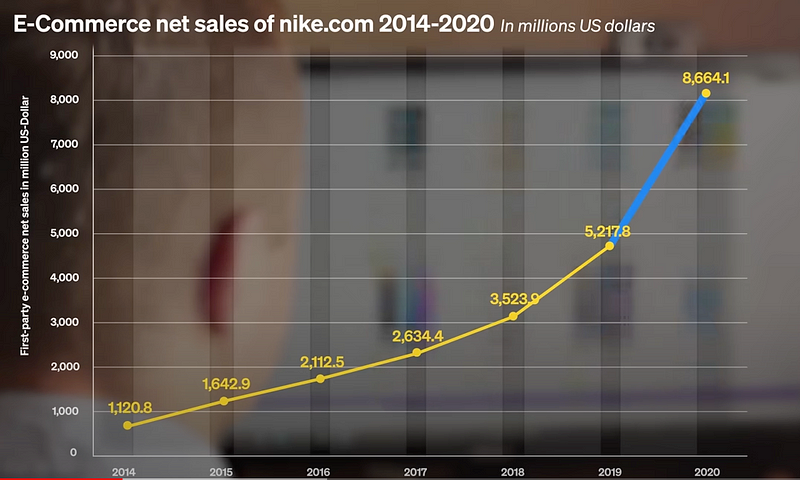
Nike, a company that once owned 38% of the shoe market, a company that always focuses on athletes and innovations. But if you look at the sales for the last quarter, they are falling. It’s the lowest since the 1990’s. Because of this dip in sales and to drive innovation, Nike has fired 2% of its workforce. Nike and the analyst are looking into the reasons for this downfall and they are coming up with various reasons for this. One such reason is “digitization initiatives in Nike”. We are going to look at this factor.

John Donohoes became the president and CEO of Nike in 2020. He has been on the board since 2014. He came to Nike with the experience of leading digital product companies like eBay, Paypal, ServiceNow etc. His presence on the board and becoming the CEO were some of the major reasons for the digital focus of Nike.

This was the time when Nike started focusing heavily on digitization and digital innovation. Nike started bidding on the “Direct To Customer” strategy by leveraging their Digital innovation and products like apps, websites, etc. During the same time, Nike started investing in its Global store concepts and four mobile apps.

Soon the sales numbers started responding positively to this strategy. 

By the end of 2020, the digital initiatives started paying off and the sales from the app doubled and 20% of Nike’s sales were through digital channels.

The Strategy and investment boosted during the time of the pandemic. During the pandemic time, the competitors were struggling to reach out to their customers using their below-par digital presence and products. Nike was able to capitalize on this gap and as a result, the digital sales went up 30%, and the membership of Nike apps went up to 160 million.

This became an eye-opener for its competitors and many other retailers.Suddenly all of them started investing in digital. 

During this time in one of the meetings Nike claimed that “Consumers today are digitally grounded and will not reverse back” and they predicted 50 % sales through online channels. They started production based on these projections. 

By this time the lockdowns were lifted globally and people started returning to the stores, the digital story slowly began to reverse the online sales started going down, not just for Nike but in general for all the retailers. As customers walked into stores they started realizing what they were missing out on while they were in the digital world. They started seeing innovation and fashion created by other brands. People started trying out new products and they started appreciating the new styles and innovations created by other brands.

No one thought this could happen nor Nike. They ran into an inventory nightmare as the products started piling up in the warehouse at the same time sales were going down.

So post-pandemic the competitors and retailers got another key takeaway from Nike, “You should always focus on your core products and never stop innovating”. Nike made this mistake with their digital-focused initiatives.

Don’t get me wrong I am not saying don’t invest in Digital. Instead what I am saying is, “Use digital strategies to innovate in your core business, and don’t try to create a new digital product”.

Never forget that the customers are sticking with you because of the product innovation, or because of the style you are bringing to the products. The experience you provide is only a wrapper. Tomorrow someone else can easily come up with a better wrapper but it is not easy for them to continually innovate like you do with your products. Hence innovative products should be the primary reason for customer acquisition and retention. Digital should be only a complementing or supporting factor for that.

The key takeaway from the pre and post-Nike story is “ Digitization is needed for all brands. While doing so, it should not become your core focus of innovation instead, use digital to drive innovation in your core business

The Flow State

Photo by Priscilla Du Preez 🇨🇦 on Unsplash

We all have this problem of getting bored. I am the one who gets bored when doing the same things again and again. When I sense boredom I try to find something which is interesting. What I have noticed (at least for me ) I can distract myself for only a certain period after that the boredom just consumes me fully.

I started talking with people who are in the same boat and realized almost all of them are in the same category. If they get bored they will try to distract and eventually, they will be consumed by that fully. Since they realize this most of them quit early before it hits them and some look for distractions and eventually get consumed by boredom.

During one of those boring days, I was retrospectively looking at the period where I was bored Vs the period I was super productive. That is when I started realizing that we are more productive when we are in the “State of Flow”.

Mihaly Csikszentmihalyi is one of the founders of positive psychology and was one of the first to identify and research about “ The Flow State”. He once said

“The best moments in our lives are not the passive, receptive, relaxing times . . . The best moments usually occur if a person’s body or mind is stretched to its limits in a voluntary effort to accomplish something difficult and worthwhile”

If you think of a time when your performance excelled and we call in the zone where we were ready to take up any challenge. That is the state of flow. Flow occurs when your skill levels and challenges match.

According to Mihaly Csikszentmihalyi below are the 8 characteristics of flow

  1. Complete concentration on the task
  2. Clarity of goals and rewards in mind and immediate feedback
  3. Transformation of time (speeding up/slowing down)
  4. The experience is intrinsically rewarding
  5. Effortlessness and ease
  6. There is a balance between challenge and skills
  7. Actions and awareness are merged, losing self-conscious rumination
  8. There is a feeling of control over the task

So the question is who can achieve this state of Flow? Studies suggest that autotelic personalities(having an end or purpose in itself) tend to achieve this faster. They tend to do things for their own sake rather than chase something.

The personality traits of this group (autotelic) are: they have high interest in life, persistence, and low self-centeredness.

We also need to understand what happens in our Brain during Flow

During the state of flow, the prefrontal part of the brain will get temporarily inactivated. This part of the brain is responsible for self-consciousness, memory, temporal integration, and working memory. This temporary inactivation results in feelings of distortion of time, loss of self-consciousness, and loss of inner criticism. This also allows our brain areas to communicate freely and engage in a creative process. You might have felt this while playing sports, games, reading, solving puzzles, etc.

How to achieve the state of Flow:

The balance of perceived challenges and skills are important factors in flow. On one hand, when a challenge is bigger than one’s level of skills, one becomes anxious and stressed. On the other hand, when the level of skill exceeds the size of the challenge, one becomes bored and distracted.

Flow State

Studies suggest that the state of flow is enjoyable when you flow together as a team. For a team to be in the flow state we need motivation. There are two types of motivation Intrinsic and Extrinsic.

Intrinsic motivation is when you do something because you love it. Mihaly Csikszentmihalyi said “The highest intrinsic motivation is a flow state where self-consciousness is lost, one surrenders completely to the moment, and time means nothing

Extrinsic motivation is when your motivation to succeed is controlled externally. That includes doing something to avoid getting into trouble or working hard to earn more money. That type of motivation is short-lived. A good kind of extrinsic motivation is when you are practicing to get better but you still need a tutor or teacher to validate your efforts.

Difference between Team & Group

A team is a small number of people with complementary skills who are working towards achieving common goals. A team is dependent on one another while holding each other accountable so they can accomplish their goals. Whereas a group is mostly independent members focusing or working on there piece of tasks.

How to lead your team toward Flow state?

For the team to be in a flow state every individual must be in the flow state. This occurs when team members can immerse together in an interdependent task that all the members are satisfied with. When your team achieves Flow state they can create greater results than the individual contributions. Some key points to achieve a flow state are:

  1. Set clear and immediate goals at every stage
  2. Receive clear and immediate feedback
  3. No agony over failure
  4. Have a balance of skill & challenges
  5. Have control over the situation and have no fear of failure
  6. Create intense and focused concentration
  7. Ensure the work itself is intrinsically rewarding
  8. Clear communication both verbal and non-verbal
  9. The process is what’s enjoyable, not the result

Effects of Flow:

Flow is often explained as a positive experience. It’s not just improving productivity but also the group’s happiness and positivity. Consistently being in the state of flow could lead to a state of stress, because once in flow, unknowingly a person easily gives everything of their capacity.

It is therefore important to know how to ‘get out’ of the flow or take a break from it. Teams, Leads, and Individuals have to understand and learn the fact that “ promises cannot be always kept and that is natural and it’s not poor planning or intentional

It is also good to understand that breaks from flow are important and natural; otherwise, they may appear sticky or even depressing periods after the joy and successful performances created by flow.

Studies found that flow experience is better when experienced together.

I would like to know if your team ever worked in flow. What did you notice? What were the results?

https://bivekrenuji.medium.com/the-flow-state-b2fe22ae938f

Need for Rediscovery

Reimagine
Reimagine

Recently I was having a meeting with a team about selecting a platform that they could use. In that meeting, one senior team member raised a point and which caught my attention.

We have established platforms, then why should we rediscover or try new methods, why can’t we just follow and use the existing ones !

Almost everyone agreed to that argument and I couldn’t complain, when you look at that argument peripherally it is all correct “Why should we rediscover everything?” 

But some things can be and have to be rediscovered right?

A couple of years back I was reading a famous book called “ One Straw Revolution” by Masanobu Fukuoka.

In that, he was telling a story about his starting point. When he was young there was an established method of farming that was passed down and perfected by generations.

But he decided to challenge that with his method of agriculture which he famously called “ Do-Nothing Farming”.

Initially, everyone called him crazy and ignored him, but after some time those who ignored him were queuing up in his old village house to learn about his new techniques.

That was really an inspiration for me. We always accept things as it is and we rarely question why?

Somethings are done or was working in a certain way for ages doesn’t mean that it is always right and it is the only method. Instead, it means that that is the only way we know and hence we believe that it is the only way to do certain things. We can and we have to challenge the Status Quo.

When we start challenging, then everyone will bring up the next biggest question -, “ What if we fail !”.

We ask that question because we all are afraid of failures, we consider failure as an end result. When you consider failure as an end result then it is always a problem but if you consider failure as a step in the journey towards excellence and success then it is not a problem.

If you look at it that way then failure is a result of only one step towards your final journey.

As Thomas Alva Edison once said “ I have not failed, I have just found 10,000 ways that won’t work

Now you could argue that “Thomas Alva Edison was not trying to rediscover Bulb

You are right he was not trying to rediscover bulb instead, “He was trying to find an alternative for candle light which was a norm at that time. A technique which was followed and perfected through generations of knowledge and experience”. He reimagined the ways of working he was ready to ask the why. He didn’t stop by just asking the why, he took the lead in finding an answer for that why.

There is no problem in not challenging the norms, but that doesn’t mean that you can’t challenge them or there is no need to challenge them. 

Those who challenge will discover new ways and during the journey they will gain the experience which no one else could acquire.

If you are ready for that journey then get ready to embrace the journey of rediscovery.

Photo by Dawid Zawiła on Unsplash

https://bivekrenuji.medium.com/need-for-rediscovery-baed6aeb17eb

An object in motion will always tend to stay in motion.

First Law Of Motion

Newton’s first law of motion states “ If a body is at rest or moving at a constant speed in a straight line, it will remain at rest or keep moving in a straight line at constant speed unless it is acted upon by a force

This is the same in psychology also “ If we taste victory then we tend to do the same thing again and again. And for some in rest or in a different path and they will continue in their path unless someone forces them to change

I have felt this resistance when I engage with companies for their transformation projects.

Let break it down and see why this is happening and how you can overcome this.

  1. Comfort Zones:

As Newton’s first law states the object will continue in its state as long as a force is being applied on it. It’s because we look for comfort zones. Because we all have weaknesses and we don’t want to expose that to the world. So the best way is to find a comfort zone and hide inside that.

But when you look at the people who achieved great heights we will find that they never cared about these comfort zones. They expose themself to new environments and changes. That allowed them to learn and adapt.

Adapting to changes it’s there in our blood but are we are trying to run away from that instinct. The first step is for companies and individuals to come out of their comfort zones.

2. Fear of Failure

When I was talking to one of the senior executives of a company he was asking me “ We are not doing bad now, we know we have issues but somehow we are delivering results. Then why should we change the way we work? And what Guarantee we have that your approach will work.’’

Instead of answering that I asked him a counter-question “ Nokia as a company was doing great and they didn’t want to change the approach based on what is happening in the industry, at the end what happened?”

We always have to look outside and see what is happening and change our course according to that. You are like a captain of your ship, you have to constantly observe and change the course of your journey else the old route which you have taken might not take you to shore.

Do not fear for change embrace it and change according to it.

3. Busy in creating an Image

When we work in projects and teams, you will notice that some will be busy creating an image for themselves. It is needed but when we overdo it then it becomes a problem.

Why people tend to over to it? Because they lack the knowledge in that area and it becomes a necessity for them to create an image that is larger than themselves. This image creating will result in unnecessary politics in the office environment.

Companies and individuals have to identify these big images getting created in the echo system which is going to eventually throw the balance off.

We should also look at why they are getting created:

 a. There is a lack of knowledge in the group so that the one with little knowledge will be considered as the champion. This also means that there is no one capable at the leadership level to identify and correct this.

 b. Leaders themself creating a picture- I have seen this happening a lot of times, leaders will be busing in portraying and creating a bigger picture of their projects. But when you dig deep into it, you will realize that the leader is not having a good understanding of the project. These leaders will eventually become toxic. One of the common things I have noticed is that this leadership will support favoritism because that is one of the ways for them to protect the bubble they have created. Most of the time this bubble and project will fail together.

4. Force the change

The last one is the force. As Newton said if you have to change the course of movement then you have to apply force. Only a force can make a change.

It’s the same in our case if we want to change we have to force ourselves and companies have to force the change into the organization.

You can bring this change in two ways, for the first approach is to force the change across the organization. This means those who cant change will get frustrated. It is like shaking a fist tank, it will take a little time to settle down. Management has to force the change and appoint the right people to drive the change so the echo system can be rested based on the vision of the company. 

The second method is to be a servant leader and force the change along with others. To do this these leaders should have a great understanding of the full echo system and also a clear view of the end goal. In this case, the disturbance is less because everyone will get a view of what they are doing and why they are doing it.

In both the approaches one thing is mandatory “ The vision’’

There are many microelements that result in a successful transformation. Because when you change a moving engine all the parts of that engine have to work together for that change. Else it will be catastrophic and will result in a big failure. So create that vision and let that vision be the force to make that change.

https://bivekrenuji.medium.com/an-object-in-motion-will-always-tend-to-stay-in-motion-4a1e90088473

Achievement, Affiliation and Power

Managing a group of people with different personalities is never easy. But when you are

Managing a team it’s essential to know what motivates the people, how they react to positive or negative feedbacks?.

Regardless of age, culture or gender, there are only three motivating factors

  1. Achievement 
  2. Affiliation
  3. Power

If you understand the three factors then you can classify the team into these buckets and then approach them based on what they need.

Achievement, Affiliation, and Power

Achievement :

It’s the urge to achieve something. People who possess high achievements are the ones who always want to excel in their fields. They tend to avoid low risk and low rewarding things and focus on high risk high rewarding things.

They avoid low-risk things because of the lack of challenge and they don’t get the real feeling of achievement in this.

These people find innovative clever ways to achieve goals and consider their achievement a better reward than financial ones. Their preference is to work in a results-oriented work environment and always appreciate any feedback on their work. Achievement based individuals take calculated risks to reach their goals and may circumvent both high-risk and low-risk situations.

This group will have two types of people those who only prefer to work alone and the others who are great team players and can drive the team together with them.

Affiliation :

It’s the urge of a person to have the social and interpersonal skills. These people like to work collaboratively and they tend to avoid high risk situations and they get nervous with uncertainties.

These individuals socialize, maintain relationships, etc. They also tend to play by the books and will tend to continue a step process. They also fear changing the process because of the fear of failure.

They feel collaboration is the way to go and they follow the workplace rules and they don’t change the norms because of the fear of rejection.

These groups of people are good in customer interactions, Client services, stakeholder management, etc. They tend to find a comfort zone and will not tend to break that comfort zone.

Power:

Is the desire within a person to Control, authority over another, influence, and change the decisions of others. For these groups of people, power is the motivation factor.

Competition motivates them because they enjoy winning arguments ( they will be motivated as long as they win the argument 🙂 )

Status, Recognitions, Position, etc motivates them. If not carefully handled these groups of people tend to become micromanagers. As these groups are motivated by power and position they tend to ignore the knowledge which they have to gain over a period of time. So it’s important to keep a check on the learning part.

As a leader, your role is to identify the personality types and handle the members according to what they need. This will help you in identifying the personality type and you will know what can be used in favor of the team and what can go wrong.

Sounds so simple, but if you look at the diagram the intersection between these personality types is going to make things tricky and complicated.

View at Medium.com

We are Born, We Grow Up and We Die, so find the IKIGAI while we are alive.

We are Born, We Grow Up and We Die

We are Born, We Grow Up and We Die…

The only thing which you can control in this equation is what are you doing while you are growing up.
Why are you doing that? Is that making you happy? You only have one life so we should make it count.
 
Finding that purpose requires balancing many things. You need to find that one thing which makes you happy. Our companies and leaders used to say we are sacrificing this for the greater good of the company, world, or country. I don’t disagree with doing what the world needs because it is important, but it should not be at the expense of your happiness. You might think of doing what you do best makes sense, but will anybody pay you for that. Because at the end of the day you need money to survive in the world.
 
This is when the Japanese principle of IKIGAI comes into play. IKIGAI means “Reason of Being”.This refers to having a direction or purpose in life.

IKIGAI

This principle can be used not just be individuals by also by the companies.
 
Before defining a catchy slogan, they should focus on finding the purpose and values. The companies with a strong sense of purpose and value will always perform better than their peers.
 
If you could align your Ikigai with those of the employees working with you, then that creates motivation and drive which eventually creates an environment with positive energy. People who are working in that environment will be driven to do their purpose and will be perfectly aligned with the company’s purpose.
 
The companies follow the same patterns as life ie. “Startup, Scaleup and Screwup” like “We Are Born, We Grow Up and We Die”. As a company, you should focus on postponing that inevitable. That is why it is important to find out the purpose, “the IKIGAI”. If that is found and served by generations of people the company can live for centuries.
 
Spend your time in finding the purpose of your company and your team. Your company’s vision/product vision will not count if it describes “the what and not the why”. This cannot be done by writing catchy phrases on posters.
 
Finding the IKIGAI is a lengthy process, So I suggest spending the time with your leadership team and team members. This should not be a one time exercise this should be done frequently so the purpose is served.
The quickest way ( not the effective way) to start with is to print the prepared canvas of IKIGAI.
 
Give the smaller version to the individuals and stick the bigger version in the room.
Ask every team member to write in their answers and post it in their small versions of the canvas. Keep in mind overthinking will over complicate. Hence don’t overthink and time box the activity to 5 to 7 to minutes per section. So that you could finish this in 30 minutes.
After this map, it to the bigger canvas. When they map it to the bigger canvas ask them to explain it. This will help you in identifying the IKIGAI (purpose )of the company, team, and individuals.

We are Born, We Live and We Die. So choose wisely and make every moment count.

https://medium.com/@bivekrenuji/we-are-born-we-grow-up-and-we-die-so-find-the-ikigai-while-we-are-alive-90592f696d6b?sk=c96d78ba98cbbb0fd8e8f14e72542556