
From Clicks to Context: Key Considerations for Embracing Conversational Commerce


Click to Context

After the last two posts, many have reached out to me, and we have had some good discussions. Thank you for all the feedbacks and sessions.

One question that keeps coming back to me in all those meetings was “How will this impact the current retail ecosystems?

That question inspired me to write this piece. In this article, I won’t dive deep into each system & scenarios, but rather provide insights and pointers on what actions to take and which areas are likely to experience change.


With Open AI Apps, the potential scenario we are going to face with e-commerce in the near future is :

More and more companies will start using ChatGPT as another channel for selling their products, which means most of the retailers will be forced to go into that channel. So if you decide to go down that route, your current e-commerce echo systems and architecture are going to have some impacts or changes.

As we transition from click commerce to context commerce, your content becomes the decisive factor — it will either make or break your success.
The conversational customer journey could be like this:

Conversational Product Discovery 

Customer opens ChatGPT and asks: “Hi <Brand:> Find me a black running shoe size 10, under $120.”

ChatGPT will show the shoe size 10 that are less than $120 

Customer: “Show me the blue one.” 

ChatGPT will look at your product feed and search data from RAG and see if you are selling blue shoes, and present that to the customer.

Customer: “Add this to cart, size 10”

ChatGPT will call the backend to create a cart and show that to the customer. 

Customer: “Checkout this”

ChatGPT calls the backend, it calculates the taxes & shipping, returns a hosted payment session URL or a Stripe PaymentIntent (if card entry required).

Customer: Enters the card details, and the purchase is completed.


In order to achieve the above customer journey, we need to do the following things:

Authentications & Cart Merges 

This will be the first touch point of change, and it’s not a biggie, but it’s a change that has to be thought through. 

Similar to how you authenticate the users from the website and apps, you need to map the ChatGPT sessions with the site/app sessions. You will have to manage the guest users, existing users, and existing users with an active cart scenarios etc.

Commerce Orchestrator

Worth thinking about creating an event-based commerce orchestrator with an MCP that dictates how your commerce flow should be. Some of the key responsibilities of this layer could be :

  1. Product feeds to LLMs and other systems
  2. Creating /Merging cart & Checkouts with different channels
  3. Payments
  4. Inventory & Price feeds
  5. Personalization
  6. Updating & retrieving from Knowledge Base 

Product Feed

Most of the retailers should expect a change in the product feed because, 


The traditional product feed from ERPs or your existing PIMs will not work for LLMs. I am not talking about the format of these feeds, instead it’s about the extra information, the information that is traditionally not part of product feeds from these systems( for eg: Including Inventory along with the product feed, Tax as final value based on regions etc)


So you could expect a change in the way you create this data and how you send this data to LLMs.

Knowledge Base 

Simply put, this is the way you can expose your products, data, and services to the RAG. This is a must, and none of the retailers have this right now. I have touched upon this in the article: SEO & AEO: Any Different?

This is a change not just in your tech echo system, but almost every department in the business has to work together to figure out all the questions they have over the period of time, create a strategy, structure it, and publish this as content on the website.

This will call for a change in the way you create content in CMS; you will have to update the product content, and it is going to be a continuous process.

Reducing Hallucinations

New term for you ? Don’t worry, it just means that RAG will read the data, and based on that data, the LLMs might hallucinate and give you a reply that is slightly off. For eg:

While chatting, the customer might ask, “Is this an all-terrain shoes ?”. The LLM will reply saying: “Yea, it’s an all-terrain shoe ” 

Customer: “Is it waterproof?”

LLM: “Yes it is “

The last answer is a hallucination of the LLM, Based on your data, it started thinking that since it is an all-terrain shoe, it should be waterproof. 

To stop these hallucinations, we have to write system prompts like :

“Do not invent product features or availability. If unsure, respond: ‘I can’t confirm that — check this product page’ and provide link/doc reference.”

We call these Evals. This helps LLMs from hallucinations

Don’t worry, there are tools out there that we can easily plug in and do this quite easily. If you are going to use Agent from OpenAI, you can easily input your evals into that.

Payments

The new evolution of AI-enabled commerce is powered by the Agentic Commerce Protocol (ACP), a new, merchant-friendly open standard codeveloped by Stripe and OpenAI. 

Your payment platforms will also soon release this. It’s not rocket science for Service Integrators because most of the work will be done by your gateway. You just have to call it in the right way:

How it works is :

After the customer chooses their preferred payment method, your payment gateway will issue a Shared Payment Token (SPT), a new payment primitive that lets applications like ChatGPT initiate a payment without exposing the buyer’s payment credentials.SPTs are scoped to a specific merchant and cart total. Once issued, ChatGPT passes the token to the merchant via API. The merchant can then process the transaction through your gateway.

Personalization

You can build this along with your commerce orchestrator or if you have a personalization engine, then pass this information, like session history + browsing + purchase history to surface products.

Expose getRecommendations(session_id, product_id) as a tool for ChatGPT to call. Keep your customers’ privacy in mind and only share the IDs and small metadata.


Above is not a comprehensive list of impacted areas, but it covers almost all the basic areas that will have changes. I tried to keep it to the basic impact level so that everyone can build on top of this.

The impact of change will be different for different retailers and is solely based on your current architecture. Your imagination and budget also plays a role in this , we could even think about adding an agentic layer in your architecture and much more.

The great thing about the new agents being rolled out across all LLMs is that development will become much faster. You’ll be able to test creative ideas more easily. I believe that in this new world, imagination will face far fewer limitations due to technological constraints.

What do you think? If there’s a specific area you’d like to discuss, feel free to leave a comment or reach out — I’d love to continue the conversation.

A digital takeaway from “The Nike Story”

Photo by Goh Rhy Yan on Unsplash

Nike, a company that once owned 38% of the shoe market, a company that always focuses on athletes and innovations. But if you look at the sales for the last quarter, they are falling. It’s the lowest since the 1990’s. Because of this dip in sales and to drive innovation, Nike has fired 2% of its workforce. Nike and the analyst are looking into the reasons for this downfall and they are coming up with various reasons for this. One such reason is “digitization initiatives in Nike”. We are going to look at this factor.

John Donohoes became the president and CEO of Nike in 2020. He has been on the board since 2014. He came to Nike with the experience of leading digital product companies like eBay, Paypal, ServiceNow etc. His presence on the board and becoming the CEO were some of the major reasons for the digital focus of Nike.

This was the time when Nike started focusing heavily on digitization and digital innovation. Nike started bidding on the “Direct To Customer” strategy by leveraging their Digital innovation and products like apps, websites, etc. During the same time, Nike started investing in its Global store concepts and four mobile apps.

Soon the sales numbers started responding positively to this strategy. 

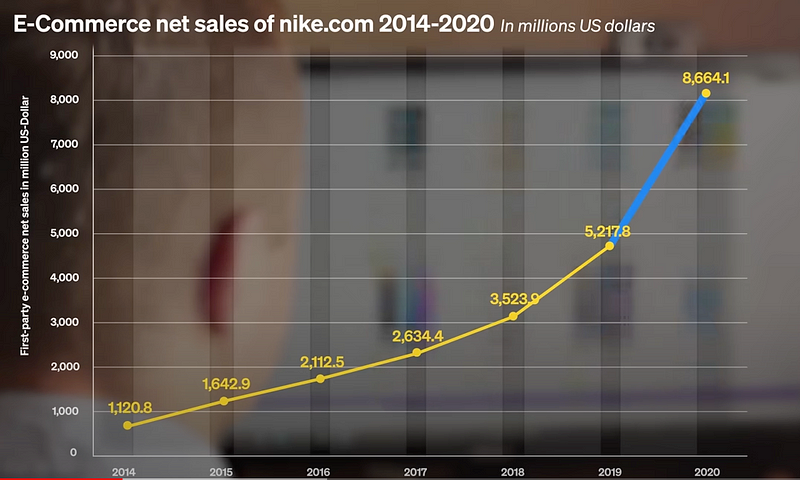
By the end of 2020, the digital initiatives started paying off and the sales from the app doubled and 20% of Nike’s sales were through digital channels.

The Strategy and investment boosted during the time of the pandemic. During the pandemic time, the competitors were struggling to reach out to their customers using their below-par digital presence and products. Nike was able to capitalize on this gap and as a result, the digital sales went up 30%, and the membership of Nike apps went up to 160 million.

This became an eye-opener for its competitors and many other retailers.Suddenly all of them started investing in digital. 

During this time in one of the meetings Nike claimed that “Consumers today are digitally grounded and will not reverse back” and they predicted 50 % sales through online channels. They started production based on these projections. 

By this time the lockdowns were lifted globally and people started returning to the stores, the digital story slowly began to reverse the online sales started going down, not just for Nike but in general for all the retailers. As customers walked into stores they started realizing what they were missing out on while they were in the digital world. They started seeing innovation and fashion created by other brands. People started trying out new products and they started appreciating the new styles and innovations created by other brands.

No one thought this could happen nor Nike. They ran into an inventory nightmare as the products started piling up in the warehouse at the same time sales were going down.

So post-pandemic the competitors and retailers got another key takeaway from Nike, “You should always focus on your core products and never stop innovating”. Nike made this mistake with their digital-focused initiatives.

Don’t get me wrong I am not saying don’t invest in Digital. Instead what I am saying is, “Use digital strategies to innovate in your core business, and don’t try to create a new digital product”.

Never forget that the customers are sticking with you because of the product innovation, or because of the style you are bringing to the products. The experience you provide is only a wrapper. Tomorrow someone else can easily come up with a better wrapper but it is not easy for them to continually innovate like you do with your products. Hence innovative products should be the primary reason for customer acquisition and retention. Digital should be only a complementing or supporting factor for that.

The key takeaway from the pre and post-Nike story is “ Digitization is needed for all brands. While doing so, it should not become your core focus of innovation instead, use digital to drive innovation in your core business

Meaning of the word: Best

What could be this?

We all use the word “ Best “ in our daily life. Not once but many times and on many occasions.

But what is the meaning of this word? According to the Cambridge dictionary, it is “ the superlative of GOOD which means excelling all others or something of the highest quality, or being the most suitable, or Pleasing, or effective thing or a person

Then what is the meaning of the word cheap? It means something low in price. Throughout life somehow the word cheap is also linked with “products with inferior quality”. This brings the notion to the customers that when you pay more you will get the BEST quality product.

If you look at this the word “Best” got linked with quality and high price.

In the new world of Retail where another word that is creating a buzz is called “Compare”.

The meaning of this word is: “ to examine or look for differences or similarities “. This word also means “ to view in relation with “

This means we need a baseline to compare something.

When eCommerce started internet became a place for comparing the prices, and now it became a place for comparing everything.

Initially, the baseline was the price, people got the habit of comparing two products based on price.

You remember the word Price was somehow linked with Quality.

People had this notion that if it is pricey then it has quality.

Globalization, internet, and eCommerce was a main force in bringing a change to this notion.

It threw a wide variety of options in front of the customers who are used to compare a minimal number of products based on price.

This created a behavioral change in the user’s way of comparing because they could see the same type of product in a wide range of prices. Hence they started comparing other things like Features, Services, Warranty, Quality, Reviews, etc etc.

So slowly internet has become a place for comparing anything and everything.

This behavioral change slowly brought a change to the meaning of the word “Best”. A word which was once linked with “ high price and quality” is now slightly getting related to “ Cheap and reliable or Cheap and Quality”

Now if you look at the google search trends for the words “Cheap” and “Best”. Search interest for “Best “ has outpaced the word “cheap”.

But the precise meaning of “Cheap” and “Best” largely varying between individuals. On the other hand, the word “Best” is getting associated with many other things like value, quality, performance, popularity, etc.

The word once Associated with Quality and high price is

now linked with Cheap, value, quality, performance, popularity, etc.

Analysis of this kind of behavioral change is essential for analyzing the trigger for purchase and consumer decision making of “ Why We Buy What We Buy “

With a lot of options in front, people explore and evaluate in the deep sea of the Internet where cognitive bias shapes their shopping behavior.

To succeed in this sea of opportunity the marketers have to understand the shift in consumer behavior and study the customers. We have to constantly evaluate and study the change in behavior of the users and words. Because when you say it is the best product, then that means “it is the best among what we have seen currently ” A new product could come up at any point of time and could redefine the meaning of “Best”. 

https://bivekrenuji.medium.com/meaning-of-the-word-best-c23b2a34c670

Requirements: Bend it like the platform

Bend it like the Platform wants

I started growing up playing and was a big football fan, have never missed any of the games. During my college days like many , I was also a fan of Beckham. We were impressed and fascinated by the impeccable ability of Beckham to bend the ball. I could remember all of those freekicks and still watch many of them on Youtube these days.

Years have passed, that generation has grown up and I also started “Bending.” The only difference is I am not bending a football instead I started “Bending the Requirements” to make sure it is matching up with the platform which we are using.

You might be wondering what I am talking about 🙂

I am working in eCommerce for quite some years and I progressed my career through many positions.Throughout this journey what I have seen is:

All the retailers want to go online and compete ( many a time survive) against the threat of Amazon.

Almost everyone wants to go online and they will eventually choose one of the platforms to make their dreams come true.

In the initial stages of the dream, the SI (Service Integrator) of the platform will promise to develop all the functionalities the client has requested for.

The client will sign the agreement and once they start the project they will start seeing the experts of the platforms. The ones who are specialists in “Bending the Requirements” (Once I was also one among them ).

They will say the all the business requirements can be achieved but, not in the way business wants. Instead, they can achieve those using the out of the box advised method of the platform.

At the end of the day, 90% of the clients will end up comprising the actual business way of doing things. Because that is not possible to achieve in the chosen platform. The clients will give a tough time to the SI’s (Fact is the SI’s will give a tough time to the clients), this is when you will start hearing about the jargons (actually these are the concerns of the SI’s & Platforms) of software updates or threats about security etc.

This is where the skill of the so-called “specialist” will come into play, “Bending the requirement to score the Goal”.

But the question is who is going to win with that Goal?

The SI will definitely win because they will deliver the project on time and within the budget. But what about the client, they have to live with this platform with bended functionalities forever.

Looks like SI is the Villan, What do you think?

If you look into this closely you will realize that it’s not the problem of the SI. Because they can only do things according to what the platform provides ( they can do some customizations but not too much ).

Hmmm….. so the Villan is the platform providers?

It might look like that but, all the platforms have an advised method of doing things and it might not be compatible with all the business requirements.

So we got the Villans its the “Platforms”

hmmm… Maybe not, Just zoom out for a moment

“doesn’t it sound like a “One size fits all” theory? Is that practical.?

It’s not possible to build a platform that can work with all the business requirements under the sun. Hence all platforms are built to works with the basic eCommerce functionalities. Plus they will allow some bit of customization ( keep in mind there are only a few which you can customize in the cloud platforms )

.. hmm so the villains are not the platforms, Then where is the Devil?

I will tell you a story which is related to sports.

In the early 2000s cricket was facing a challenge. The shorter format of the game is one day long and the millennials were not patient enough to sit that long and watch the game. The game started losing its popularity.

Whereas, football is a game of rush of blood and full of energy for 90 minutes.

So in 2008, the cricket world came up with a new format called “T20”. Which is a much shorter version of cricket and the new generation will get the same or equivalent feel of football. It became a success and then this format of leagues started showing up in different parts of the world.

You might be thinking how is this relevant:

The cricket world could have gone ahead and drastically formated the game like football. Instead, they went and looked at the core of their business and kept that intact, and played around with other features like time and overs.

The retail business should do the same, look at what is their core business offering and differentiators. How they are different from their competitors and what is the uniqueness they have in the Brick and motor operations. We should try to offer all of those in the same or even in a better way in eCommerce.

So before finalizing the platform you have to see if your core features can be achieved and not just the core of eCommerce functionality can be achieved.

If platforms are not allowing you to do your core business be bold and take steps to custom build those features. You can do that either as a customization to the platform or as microservices. This way you won’t lose your core differentiators.

So essentially the retailers and SI’s have to avoid bending requirements like the platforms. Instead, “Bend the platform to achieve what the business wants without breaking it and make sure you don’t compromise on your business needs”.

https://bivekrenuji.medium.com/requirements-bend-it-like-the-platform-91a7770b43ec

New normal: For some, it’s not e-Commerce instead it’s Compelled Commerce

New normal for some in eCommerce: Compelled Commerce

During my last vacation, I wanted to buy a mixer grinder for my Mom, I went online and researched different products and nailed down to a couple of them. Then after discussing with my mom and wife I decided to go to the shop and buy it ( the instant gratification thing).

I went with them to one of the oldest and biggest brick & mortar electronics retailer in our home town. We straight away asked for the product which we were looking for and the front office allocated a saleswoman to us and she took us to the third floor of the shop.

She showed us the product, it was the same but the price in the shop is much higher than what I have seen online. Then I asked her is this the final price, she said ” Yes sir! this is the discounted price”,

I pulled out my phone and started verifying the price online. We saw the price in the online platform is much lesser. I showed her the price online and the discounted price she mentioned was the listing price in the online site. Plus they are now selling on a 30 % discount on top of that. Hence I asked why is this so, You don’t have to give me the same price as online but the difference is so huge.

She got irritated and said “ Then sir please buy from there and she started walking to the ground floor” and she continued “e-Commerce is so simple they just list the product and send it to the customer when someone buys it. We cant do that as we have additional overhead charges”

After hearing that comment I decided to get rid of my instant gratification feeling and buy online.

A year later, Now the same retailer is forcing themselves to be online. Now they are realizing that listing online and selling online is not that simple.

The pandemic has pushed almost every retailer out of there comfort zones and almost everyone is trying things online, many started listing their products in online market places, and others have started working on their websites.

We should consider these groups as “compelled commerce” and not eCommerce. Because they didn’t want to do it earlier or was not ready to covert the brick and mortar concept to a digital-first mentality. Now they are forced to do eCommerce and hence we should call them compelled commerce.

Will they all succeed? What all they should consider doing before jumping into eCommerce?

Small businesses can right away start the eCommerce journey but it’s not that easy for the big brick and mortar only retailers. 

You might be wondering why? If the small players can do it then why can’t big players who are already in the market for such a long time with these many networks of stores?

When you decide to move on to (or forced to ) eCommerce don’t start looking at the competition and see how their sites are looking like, what functionalities they have and then try to copy those. Because they might have invested in proper eCom platforms a long time back and they will have proper back end systems to support those.

Almost everyone thinks  eCommerce as what you see on the website, but the fact is the devil is in the backend. Which includes backend systems and backend operations, you will realize this only after starting the operations.

So when you are forced to start suddenly you won’t have the backend systems or operations ready. All of these have to be handled manually. 

Doing a manual operation of listing products online, updating stock, price, and all operations until last-mile delivery packing is easy for a small business. Because they have a fewer number of products, and less number of locations to manage. But for a brick and mortar retailer, this is exponentially higher plus they will have one or more backend systems already existing. This makes it extremely difficult to manually manage everything.

So what should you do,

Look at your customers and see how can you offer your products to them by keeping the same advantage or edges you have in the physical stores. Give priority to this and start building a decent frontend experience.

Along with this, you need to look at the skeleton of your eCom infrastructure and see what all weapons you have in your arsenal. How can you use them to compete with your competition? Do you have the budget to build that? If not then think about what best can you do with the current systems. Because almost every business will be cautious in spending money right now.

Take a look at the 10 basic things a brick and mortar retailer has to do before they decide to go online

  1. Understand your product
    • How is your buying pattern?
    •  What is the frequency of replenishment & newness?
    • How you buy your product
      • As packets
      • As individual items 
  2. Do you have product data saved in your system if Yes, what is the quality of that 
    • Product content
    • Photoshoot
    • How to get items for photoshoot 
    • Do you need multilingual content
    • How to set up a photoshoot pipeline 
  3. Store and warehouse operations
    • How you store your products ( Physically in the warehouse)
    • How many warehouses/Stores you have 
    • How are you handling replenishment cycles
  4. Identify the products for eCom 
    • Don’t plan the entire range for eCom, Instead plan to increase the range on an iterative basis 
    • Identify seasonal products
    • The range you carry online should be in line with what you carry in-store at that time of launch
  5. Platform and Integration for eCom
    • E-com Platform
    • How to integrate with your eco-system or do you even need integration
    • What all backend systems do you have 
  6. For a quick launch which all systems have to be manually updated     
  7. Payment 
    • COD
    • Credit Card
    • Click & Collect
    • Payment gateway
  8. Fulfillment Location
    • Store fulfillment
    • Warehouse fulfilment
    • Fulfill from both ( This is not advised without integrating the systems)
  9. Carrier partner for delivery
    • Forwards
    • Returns
    • Packaging
  10. Customer care
    • Most of the brick and mortar retailers won’t have customer care
    • Set up a customer care 

These are just the basics you need to think of before going live. Along with this exercise you have to do competition analysis, but keep in mind that you cannot outrun them because you are doing “Compelled commerce”.

If you have a long term plan for eCom and compelled commerce being your very initial crude version then it is still ok strategy to start with. If it is not this way, then all Compelled Commerces are going to Rest in Peace.

View at Medium.com