Atlas, the OpenAI browser it’s incorporating ChatGPT, or a browser where ChatGPT is the default interface. It can complete the tasks without always redirecting you to a URL.
Most of you might have thought that all it means is just fewer clicks, but the real story is much bigger than that.
Many think it is just another browser that finds results. It’s not about what it does; instead, it’s about how it does what it does is going to change the SERP game.
ChatGPT itself is a search engine; it runs queries, scrapes the internet based on user queries, summarizes the results, and presents them to you.
With “Atlas,” it’s different, not just Atlas; the Google AI search is also similar to this. These browsers are like agents; they can interact with your JavaScript (JS), which is being used to render your front end.
This means that the SERP game is going to change. If your site has bad JavaScript or is slow, then you won’t appear.
“Find me the new version of adidas black adizero evo shoes size 10.5 that can be delivered by EOD tomorrow”
and searched on Atlas and normal Google Search (Not the Google AI search). When I looked at the networks tab, I found something fundamentally different that sparked the thought about the change that is going to happen in SERP
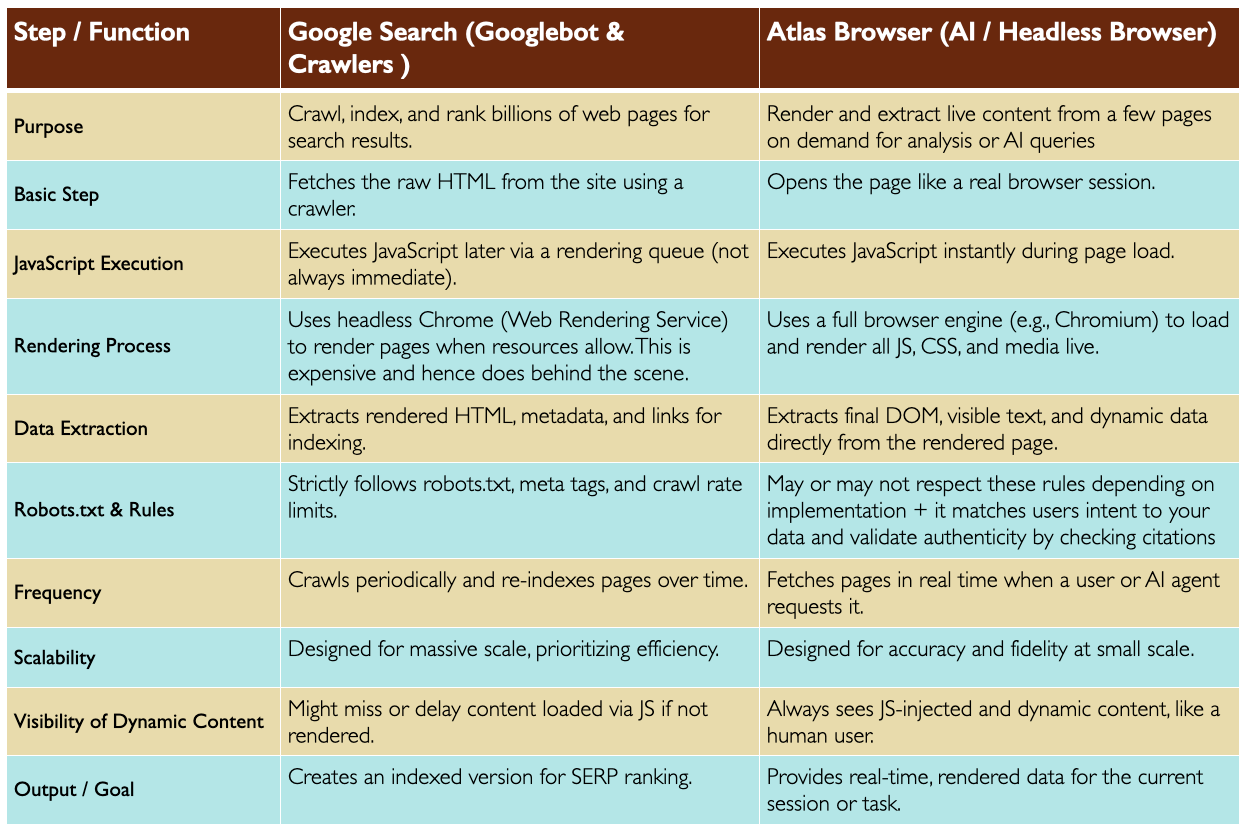
Atlas Search VS Google Search
This is where “ How it does what it does” makes the difference:” It’s immediately rendering all the JS like how a human sees it.
I am not saying Google Search is not rendering the JS for SERP results. Instead, it means
“It is done behind the scenes” VS. “this is live, like the same rendered content like how humans see.”
Let’s look at some of the general differences:
How Atlas Searches
This is where I believe the SERP game is going to change.
When the user is searching with a specific intent and context, the normal SERP of search engines is going to fail. As tools like Atlas and similar browsers begin to interpret user intent more deeply, the real question becomes: how do you serve that data effectively?
Some quick wins could be:
It’s not just about crawlers and indexes
It used to be a world where website data was optimized for bots and crawlers, just to appear on the SERP. That game is changing. Browser agents like Atlas will now render your site, execute your JavaScript, and extract exactly the information the user is looking for.
As we discussed above, browsers like Atlas or Google AI search or any other AI tool are going to render the JS during the normal page load lifecycle and can start analyzing DOM nodes and network responses during the initial render. This means it sees the same rendered content a human user sees (including content injected by JS).
So make sure you clean up your crappy JS ASAP. Make your site is Agent-readable.
Your Website = A Repository of Information for AI Systems
We are one more step closer to accelerating the theory, which I have written in SEO & AEO: Any Different?
Make your websites ready for agents to read and interpret all relevant data. You have to structure your data properly so that the browser agents can resolve the user queries much faster. This has to go hand in hand with the performance of your frontend.
I feel that in the new world, you should be making sure your site is ready for agents to read. This doesn’t mean the traditional SEO work is not needed, but this is on top of what your were doing or what youre were ignoring.
This further strengthens my belief that :
In the near future, your websitesare likely to evolve to become a repository of information for AI systems and search models rather than relying solely on direct user visits.
I’d love to hear your thoughts and ideas on this — feel free to share them in the comments or drop me a message.
Yesterday ( 6th October 2025), ChatGPT introduced apps you can chat with inside ChatGPT. This means you can launch an app inside ChatGPT. Yeah, you read it right, you can.
“Your customers can chat with your brand through ChatGPT!”
The most important questions are:
How will this work
OpenAI’s Apps SDK is going to enable brands to create custom interactive apps inside ChatGPT, and these apps are going to look native within ChatGPT. These SDKs provide full control over the backend and frontend, allowing brands to customize their offerings and products directly within the chat interface of ChatGPT.
All users have to do is ask for the app name.
Imagine your company named XYZ selling shoes online then :
Your customers can type this inside ChatGPT: “XYZ, find me size 10 black shoes of Adidas ”
Boom! There you go.
Sounds exciting and amazing right?
What does this mean for you:
This means that you can deliver services & products directly to your customers who are in the discovery phase inside the ChatGPT. That is, instead of competing for customers’ attention, you can and have to compete to be genuinely helpful to your customers.
This also means that:
“In the near future, your websitesare likely to evolve to become a repository of information for AI systems and search models rather than relying solely on direct user visits.”
Should you do it? If so, how to do it?
Currently, ChatGPT has 800 million active users. Which means your brand can reach out to all those users. Not just that, there is the early bird advantag also.
Right now, this is available in preview from Oct 6, 2025, and they will be rolling out more details in the coming months. The brands that build apps during this time will have a significant advantage for sure.
What experiences can you create?
Using the Apps SDK you can create interactive applications inside ChatGPT by using your data, products, and services. You can expose your data to these API’s using MCP servers.
Some quick wins for the e-commerce app, using this SDK
These are a few quick wins that came to mind while listening to this, and I am sure there will be more.
1. Product discovery:
You can make your entire catalogue available in ChatGPT. So the customers can type:
“XYZ, find me the new version of adidas black adizero evo shoes size 10.5”.
The customers don’t have to visit your website or app to browse and find the product instead, they can do it directly from ChatGPT.
2. Transactions:
If they like the product, they can complete the purchase from ChatGPT itself using the new Agentic Commerce protocols, which offer instant checkout from inside ChatGPT.
3. Your Services
You can offer your services directly from the app. Imagine you are providing sneaker customization and fixing. Then the customers can ask for help on how to fix something, or they could even book an appointment for customizing their sneaker using ChatGPT.
How to prepare the APP and data.
This is not like the traditional app, where the UX and UI were driving everything. But when you move to the world of OpenAI apps, you have to forget the traditional way of thinking and reimagine all your interactions from a conversational point of view.
1. Customer Journey:
The traditional customer journey is based on page-based thinking. These traditional journeys, which we are used to won’t work anymore. Instead, look for the most common questions and patterns of asking questions. As I have touched upon in one of my other articles (SEO & AEO: Any Different?), all the customers’ questions became very, very important. This is the foundation of AI native conversation apps.
2. Your Data:
We need clean data, and that has to be accessible dynamically through conversational interfaces. All your product data will become more relevant now. If you have a CMS, then enrich all our data, keeping the conversational interactions in mind, and answer all possible questions customers might ask. This is where I am forced to believe that eventually the websites will become a repository of your data and services.
How will you be able to measure success in this world?
This is something we have to observe and learn in the coming days, but what I believe the key metrics might be:
LOI (Length of Interactions):
Similar to how long your users used to spend on your site/app, you have to measure the length of conversations, satisfaction, whether they got what they were looking for, resulted in a conversion etc.
Problem Resolution
Are you able to resolve the customer’s problem within the conversions? Based on this, optimize your data.
LTI (Life Time Interaction)
Life Time Interaction tracks how customers’ interactions evolve over a period of time. This will help you in gaining trust and eventual conversion.
My Take on this
I believe this is a platform shift similar to how App store changed the mobile app ecosystem. This would require a ground-up rethinking in terms of interactions, product data, service offerings, support data, customer data etc.
It all comes down to how quickly you can adapt — the sooner, the better
Almost 2 years back, when I was working with one of my clients, he asked his SEO team: “How can we get shown up in ChatGPT”? The answers were quite different, and most of them were not quite sure how to approach this.
Fast forward two years, and we started seeing changes in the way ChatGPT presents the results and became a new channel in revenue generation. Seems like many were ignoring or were not aware of it.
Recently, I heard the same question in the meeting room and the responses weren’t much different. During that meeting, I encountered numerous obnoxious comments, such as…
SEO is going to die.
3. You can’t optimize for AEO
4. Someone even gave an obnoxiously big quote to do AEO.
5. and many more
It was all a mess. The big takeaway question I have is, “ Are they different? Is SEO going to die? I will try to simplify things as much as possible, so let’s dive in!
Before we start, let’s first look at the basics and definitions.
AEO → Answer Engine Optimization (some people will call this GEO, but don’t worry, it’s the same. It just means Generative Engine Optimization, but I prefer and believe the first one is a better choice of words because generative engines mean that they can generate images, videos, etc, but our context is around text.)
SEO → Search Engine Optimization
I am not going to explain this here. Because there is already a wealth of information available online about this, you can explore further by reading…
The first question is: Is it worth investing money and effort into doing AEO optimization?
The simple answer is Yes! Because, as per the latest data, the conversion from LLM is 6X better than Google. After the latest update of ChatGPT, the search results are showing up as tiles and clickable links; the conversion is going to go up even further.
So, how can you show up in LLMs?
How do you show up in LLM chats, like ChatGPT, Perplexity, Claude etc.
In order to understand this, we need to look at how this used to happen in the SEO world.
Simply put, in traditional SEO, we used to create landing pages for high-volume keywords. Over a period of time, you will get domain authority, get value for your url, etc.
With AEO, this stays the same, but the Head and Tail are different.
For those who don’t understand head and tail in SEO:
Head or Head Terms: Head terms are phrase that refers to keywords which are broad in nature and have a high volume of monthly searches. For eg: Shoes, running shoes, pet food, pet toys etc..
Tail or Long-Tail: Long-tail keywords are the more specific, and therefore less frequently searched-for, phrases related to a chosen topic and its head terms. for eg: “wide toe box running shoes”, “best dog toys for angry dogs”
What’s different about the Head in the AEO world?
If we simplify things in the AEO world, the head is whatever you do in SEO plus + getting as many mentions in the citations. If you get mentioned in a citation, you will eventually start showing up in the LLMs.
What’s different about the Tail in the AEO world?
The tail is larger in chat because of the follow-up questions. As per the latest study, the average words in an LLM tail is 25 vs 6 in traditional SEO.
So basically, this means certain things are in our control, and that you could optimize.
Before looking into those, let’s try to understand how LLMs are finding information in a simple way.
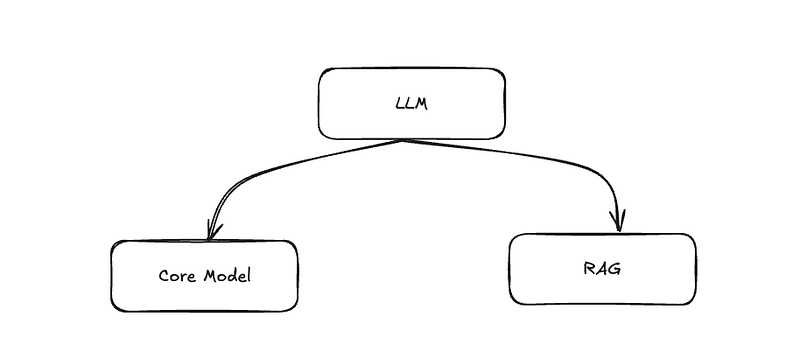
Learning Models of LLM
At a high level, the LLMs have two core learning modules: the Core Model and the RAG( Retrieval-Augmented Generation).
Leaning Models of LLM
Core Model:
This crawls millions and millions of web pages and trains the model. This is as if we read books and get knowledge about the world.
For example, if you type who invented the electric bulb, then it will automatically predict the next word “Thomas Alva Edison”.
RAG (Retrieval-Augmented Generation):
This is the equivalent of a search. This means that LLMs do the search and then summarize the search in simple English.
So if we know how and where LLMs look and value more, we could optimize and get our results across to LLMs using the RAG module. Because influencing or changing the core model is not easy and would require a lot of effort, it may not even yield the desired results in the near future or not at all.
Onsite & Offsite Optimisation
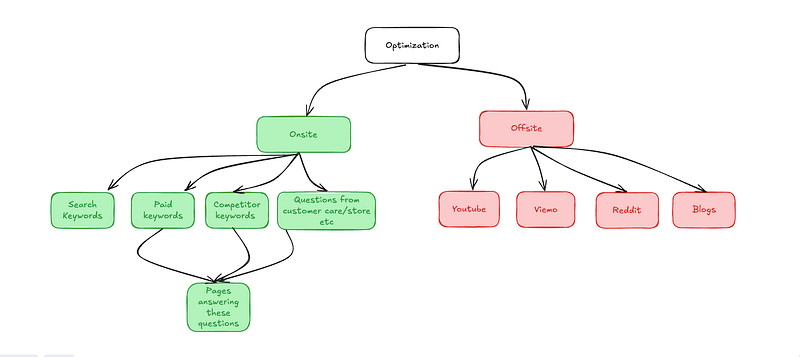
So let’s look at what’s in your control and what you can do: There are things you can do onsite and offsite. We are not going to go into detail, as this is intended to give a high-level idea and a real starting point to understand the topic.
Optimization
OnSite Optimization:
Anything that you can do on your site is called onsite, like site content, pages, indexes, etc. These are things that are 100% in your control.
Remember the point AEO = SEO + Something Extra.
What are these “ somethings”? The strategy for finding some of those perks is:
Find the questions people ask, then answer them as much as possible on your site
If you could create a page with all the possible questions users will ask, then you could win this. But the question is, how to find these questions?
Step-1 :
Take the search data, find the keywords from that. Use these keywords and create questions for those using ChatGPT.
Step -2:
Identify all the keywords currently being bid on in paid. Use these keywords and create questions for those using ChatGPT.
Step-2:
Find the keywords your competitors are bidding for. Same as above, create questions for those using ChatGPT.
Step-3:
Get all the questions which is being asked to your customer support teams, store team, delivery teams etc.
Step-4:
Answer all of these and create landing pages for these. If you are an e-commerce company, then you could even answer some of the product-specific questions in the product page itself.
Key takeaway: The more questions you answer, the better
Off-Site Optimization:
There are many things that you could do, but we are trying to cover only the high-level and the basics. You need to strategize for each of these and execute and evaluate them continuously.
1. Who is showing up in Citations?
Citations are sites or content that talk about your product or company, so that you sound more authentic. Sounds like traditional SEO, right? But LLMs have a slightly different way of looking at this(maybe this is another topic for another day).
Search about yourproduct or content in LLMs and check which citations are appearing — this tells you where you need to have a presence. These are some quick wins
“The basic rule is that the more citations, the better.”
2. Some trusted places LLMs refer to and value for citations
These are some of the places LLMs value the most ( this is as if now, and these examples are generalised for all LLMs. This might & will change in the future)
a. Youtube
b. Viemo
c. Reddit
d. Blogs
e. Credible sites
In the above YouTube and Vimeo videos are easy wins. Another quick, but expensive strategy will be : If you are ready to spend money, then you could get referred to some of the prominent players in their content (citations). This will be expensive but an easy, risk-free winning strategy.
Difference between Search and LLM
In search, it targets thousands of keywords on one page and matches them against the search term. In the case of LLM, instead of keywords, it looks at questions and follow-up questions, then it makes context out of it before showing the results. This means if you provide answers to those questions, you have a chance of appearing in the results.
Now that we understand the basics, let’s look at what happens when someone searches for “wide toe box running shoes” in an LLM.
First, it looks at its internal knowledge (core module) and sees if it has relevant information. If so, it responds almost instantly. If not, it will deploy the RAG to fetch the results before generating a response.
This is where your onsite and offsite optimization will come into play, and “voila, you are there!”.
So now, coming to the most important question, which we asked at first: Is SEO going to die? Is SEO different from AEO?
Simple answer to both is: Not really!
We have been hearing this theory that “Google search is going to die”, for a long time. We have heard this many times with the launch of Facebook, Insta, TikTok, etc., but the fact is, Google hasn’t died and is not going to die anytime soon. Instead, all of these have become new channels to businesses.
So LLMs are going to be another channel, probably the most converting channel. ( This is already happening- you might not be able to see this in your analytics. Why you are not seeing this is a whole topic of its own (maybe another topic for another day).
Second part of the question: Is SEO different from AEO?
I would say there’s definitely a lot of overlap, and the basics of SEO remain the same. At the same time, AEO requires some additional efforts, and that will complement SEO.
I tried to keep the explanation as simple as possible to give you a basic understanding of how this works. We have barely scratched the surface, but I believe this gives a solid starting point to build your knowledge further. I would love to hear your thoughts and take on this in the comments…
Nike, a company that once owned 38% of the shoe market, a company that always focuses on athletes and innovations. But if you look at the sales for the last quarter, they are falling. It’s the lowest since the 1990’s. Because of this dip in sales and to drive innovation, Nike has fired 2% of its workforce. Nike and the analyst are looking into the reasons for this downfall and they are coming up with various reasons for this. One such reason is “digitization initiatives in Nike”. We are going to look at this factor.
John Donohoes became the president and CEO of Nike in 2020. He has been on the board since 2014. He came to Nike with the experience of leading digital product companies like eBay, Paypal, ServiceNow etc. His presence on the board and becoming the CEO were some of the major reasons for the digital focus of Nike.
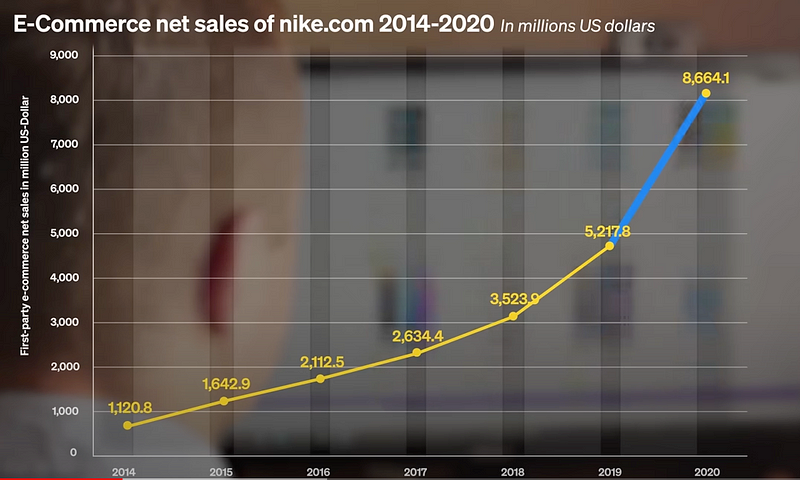
This was the time when Nike started focusing heavily on digitization and digital innovation. Nike started bidding on the “Direct To Customer” strategy by leveraging their Digital innovation and products like apps, websites, etc. During the same time, Nike started investing in its Global store concepts and four mobile apps.
Soon the sales numbers started responding positively to this strategy.
By the end of 2020, the digital initiatives started paying off and the sales from the app doubled and 20% of Nike’s sales were through digital channels.
The Strategy and investment boosted during the time of the pandemic. During the pandemic time, the competitors were struggling to reach out to their customers using their below-par digital presence and products. Nike was able to capitalize on this gap and as a result, the digital sales went up 30%, and the membership of Nike apps went up to 160 million.
This became an eye-opener for its competitors and many other retailers.Suddenly all of them started investing in digital.
During this time in one of the meetings Nike claimed that “Consumers today are digitally grounded and will not reverse back” and they predicted 50 % sales through online channels. They started production based on these projections.
By this time the lockdowns were lifted globally and people started returning to the stores, the digital story slowly began to reverse the online sales started going down, not just for Nike but in general for all the retailers. As customers walked into stores they started realizing what they were missing out on while they were in the digital world. They started seeing innovation and fashion created by other brands. People started trying out new products and they started appreciating the new styles and innovations created by other brands.
No one thought this could happen nor Nike. They ran into an inventory nightmare as the products started piling up in the warehouse at the same time sales were going down.
So post-pandemic the competitors and retailers got another key takeaway from Nike, “You should always focus on your core products and never stop innovating”. Nike made this mistake with their digital-focused initiatives.
Don’t get me wrong I am not saying don’t invest in Digital. Instead what I am saying is, “Use digital strategies to innovate in your core business, and don’t try to create a new digital product”.
Never forget that the customers are sticking with you because of the product innovation, or because of the style you are bringing to the products. The experience you provide is only a wrapper. Tomorrow someone else can easily come up with a better wrapper but it is not easy for them to continually innovate like you do with your products. Hence innovative products should be the primary reason for customer acquisition and retention. Digital should be only a complementing or supporting factor for that.
The key takeaway from the pre and post-Nike story is “ Digitization is needed for all brands. While doing so, it should not become your core focus of innovation instead, use digital to drive innovation in your core business”






 Trooming