
What is Culture? & A Silent Casualty in the Agentic Era.

Culture, a word we are so proud of. 

Every society and every company is proud of its culture and believes that it is the epitome. Like, some companies with truly questionable cultures also claim they are the epitome of culture.

Have you ever wondered what this culture is and how it forms and shapes?

The most famous definition of culture is by the English anthropologist Edward Burnett Tylor.

“Culture is a complex whole encompassing knowledge, beliefs, art, morals, laws, customs, and other capabilities and habits acquired by individuals as members of society.”

If you examine the cultures, this is something that is unique to humans; no other animals possess this. Rest, all animals have behavioural traits and not cultural traits.

That is one non-debatable topic that only humans possess culture. With the GenAI and humanoid robotic era non-humans are going to enter our workspace or already are in our workspace.

How are businesses and companies that are so proud of their culture going to handle this? How are you going to teach your company culture to GenAI?

Let’s look at the layers of culture:
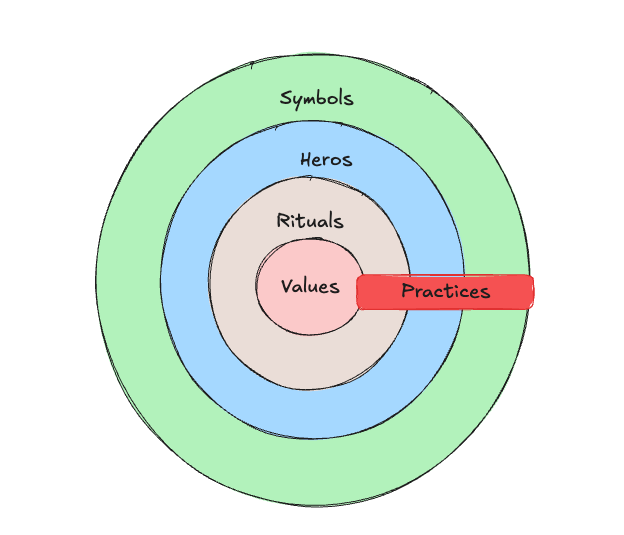
Layers of Culture

Symbols

The outer layer of culture is Symbols: These are words, gestures, objects, pictures, etc. that carry a particular meaning.

Your company logo is one among them; the way you treat the people, how you communicate those, etc, defines the symbols in your company.

Heros

There are real or fictional persons, in the past or present, who stood for the group or company. They serve as the model behavior.

This could be anyone in our company who stood and fought for the values of your company. You need a heroic story of a group of people or a person, or a project that you can quote and remind people that this is how we used to do this and this is how we will continue evolving. This will be passed on to the generations to come, and that will help cement the culture.

Rituals

These are collective activities; these are social necessities. Sometimes these are not necessary in reaching the objective. Like ways of greeting, showing respect, ceremonies etc.

In your company, this could be your stand-ups, town halls, how you greet each other, how you conduct meetings, when, and how.

Values

This is the core of every culture. These are states of affairs that define Good & Bad, Right & Wrong,etc. Values can only be inferred from the way people act under different circumstances.

If you look at the diagram, culture is like the layers of an onion. When you start peeling away the layers in search of the “real” onion, you won’t find it — because those layers are the onion.

In the same way, without all of these layers, there is no culture.

The visible aspects of culture are its symbols, heroes, and rituals, and these are the elements we can see, hear, or observe in everyday practice. The real meaning behind these things is connected to values, beliefs, and practices. This drives emotions, and this is invisible and intangible.

In the world of Agents, Humanoid robots, and GenAI, it will be difficult to create these emotions. So how are you going to create a culture, or how are you going to keep your culture intact? 

As we discussed earlier, culture is something that is possessed and followed by only humans. In the new world, the leaders of the companies are going to play a more important role than before in determining and making sure the company is staying true to the culture.

Some of the changes that are going to happen are:

1. Companies don’t need a big team

This is a sad truth for some, but the reality is we don’t need big teams to deliver a project anymore. Fewer people to manage, fewer meetings to survive… project managers might actually be smiling at this one 🙂 .

This means that your heroes or heroic stories of projects have to come from this small group. The leaders in these projects have to stay true to the company culture.

2. More Agents:

Agents will be deployed not just on the dev side but also in all aspects of business, from customer service to reporting to operations, to content, and to almost every aspect of business.

You need to inject the symbols and values into these agents. You should be tuning and training your customer service agent to keep the tone of voice the same as the brand does. The content agent should be generating the content, keeping the brand values in place. The operational agent should control the operations, keeping the process, tone, and methods aligned to the brand’s values and cultures.

If you just roll out an agent without defining and fine-tuning this, then its going to kill your culture.

In order to make sure this is in place, you might have to write Evals, track them, and optimize them continuously.

3. Resources in Payrol Vs Resource on Demand

I believe that as agents continue to evolve and mature, companies will start relying on fewer full-time employees. Instead, they’ll increasingly onboard talent on a project or product basis, releasing them once the work is complete. Much of the work previously handled by these roles will soon be automated by intelligent agents. As a result, organizations will view this shift as an opportunity to significantly reduce operational costs.

From a cultural perspective, this shift poses a potential threat. As people join from different backgrounds, collaborate for short engagements, and then move on, maintaining a consistent culture becomes challenging. Therefore, clearly defining and reinforcing your company’s practices and rituals in every project will be crucial.

However, these practices shouldn’t feel rigid or imposed — they should naturally integrate into the way of working within each project. If you fail to define them, individuals from diverse environments will bring their own ways of working, and over time, your organization may lose its unique identity and culture.

3. Mini-Culture for every project

Since every project is going to onboard different people at different points of time. You need to have a mini culture that fits the delivery. This should be a subset of your company culture that is consistent in values but flexible in execution.

For example, if your company defines a development process, it shouldn’t be overly rigid. The process should outline what needs to be done, not dictate how it must be done.

Think of it like:

Instead of saying, “You must eat three meals a day — breakfast, lunch, and dinner — and breakfast must be a three-course meal with specific dishes,” you simply set the expectation that “You must have three healthy meals a day.”

This allows individuals the freedom to choose what and how they eat, based on their context and availability, while still aligning with the core intent of staying healthy.

Now, bringing this back to your project, defining a process like this helps ensure that every team carries out a code review. But the format and who conducts it can change based on the systems, platforms, and technologies involved.

How can you preserve your culture?

All the best!

(Not joking — it’s not going to be easy, especially for those self-proclaimed “great culture” champions.) The real test begins now.

Your leaders and senior folks will have to step up and play a truly crucial role. Maybe take another look at that onion diagram and honestly reflect on what needs to change — the how and the why.

I believe this is something that we have to carefully consider, even when we are racing to keep up the pace. What do you think?
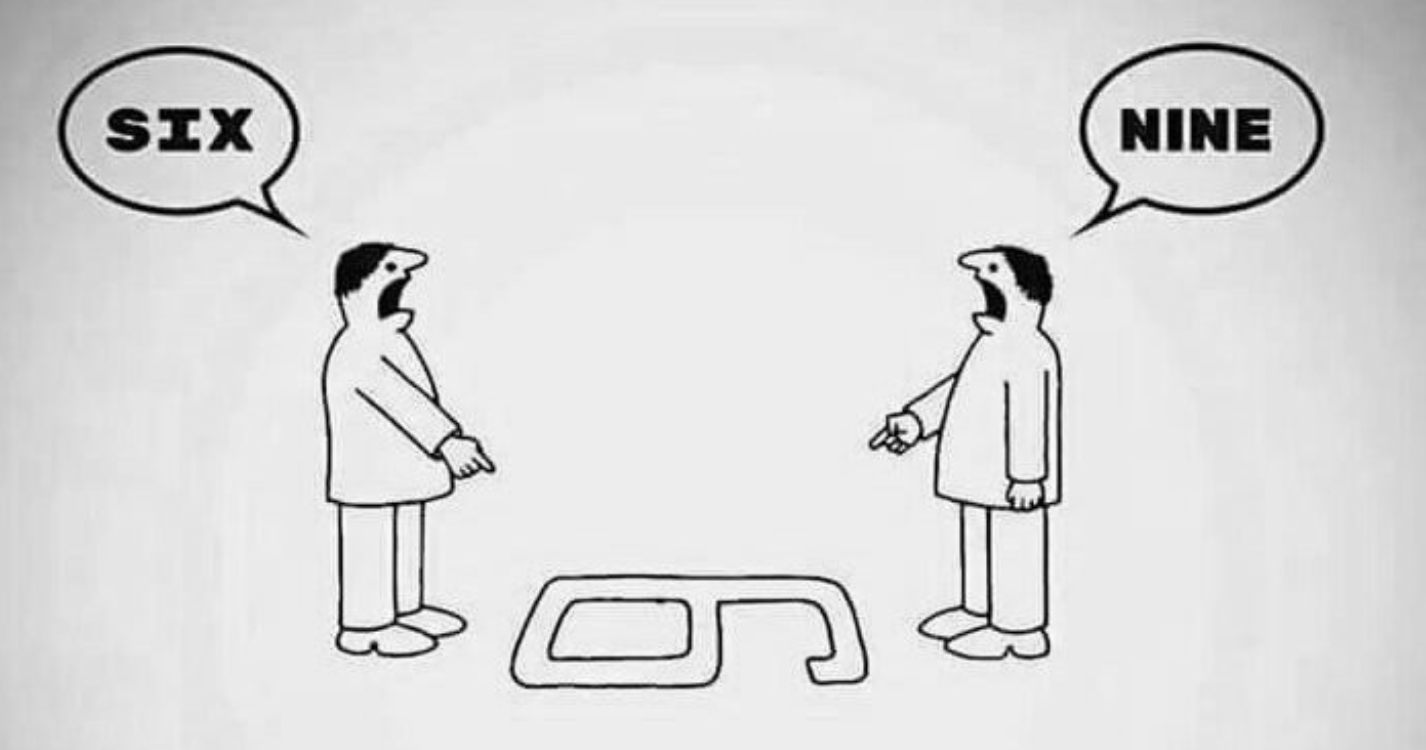
When you are right doesn’t mean that the other person is wrong

A common misconception in arguments is that if you can prove yourself right then the other person is automatically wrong. 

Nowadays if you switch on the news channels you will see people arguing to prove their point, even the news anchors are fighting to prove their point.

This thought process and the influence of social media platforms have resulted in political polarization. The world is diverged towards ideological extremes, which are far from the center.

This results in intolerance, and this Socio-Religious intolerance is increasing day by day. Leading social media platforms are playgrounds for everyone to argue, comment and contribute in any format. In this process they new care about facts, they just want to prove that they are right.

Have you ever thought why are they fighting so hard to prove their point?

This is because we always think of the result of arguments as binary, ie. If you could prove yourself right then the other person has to be wrong. 

Is that really so? 

Let’s have a look at the two answers we have :

Right and Wrong

What makes someone right/ when is someone right / What is the definition of being right?

The definition of “Right” according to Britannica is :

The meaning of right depends on whether you use the word before or after the noun

  1. When it is used after a noun then the meaning of the word “Right” is “Morally or socially correct or acceptable”:

Eg: Stealing is not right

2. When it is used before the noun, then it means “you are agreeing to a fact or truth”

Eg:

 a. The right answer is — 

b. She was right about him not having a job.

The second one is more related to tangible augments which data, proofs, facts, etc can justify. So let’s look at the first one:  

It says right means “ Morally or socially correct or acceptable”

So the immediate next question will be who is defining morality/ what is socially right /acceptable for society. The answer is not that simple.

Social norms are the perceived informal, mostly unwritten, rules that define acceptable and appropriate actions within a given group or community, thus guiding human behavior. They consist of what we do, what we believe others do, and what we believe others approve of and expect us to do. Social norms are therefore situated at the interplay between behavior, beliefs, and expectations.

These social norms, morality, or acceptability vary between ethnicities, cultures, countries, regions, companies etc..

For example, it is socially acceptable to smoke weed in some societies VS some don’t socially accept this and consider this a criminal offence.

Imagine two guys from these two societies arguing about it. Then how can you prove who is right and who is wrong? It will be like below:

So when you are right doesn’t means that the other person is wrong. Instead, it just means that you haven’t seen life from the other side.

https://bivekrenuji.medium.com/when-you-are-right-doesnt-mean-that-the-other-person-is-wrong-481f0b5a0233

An object in motion will always tend to stay in motion.

First Law Of Motion

Newton’s first law of motion states “ If a body is at rest or moving at a constant speed in a straight line, it will remain at rest or keep moving in a straight line at constant speed unless it is acted upon by a force

This is the same in psychology also “ If we taste victory then we tend to do the same thing again and again. And for some in rest or in a different path and they will continue in their path unless someone forces them to change

I have felt this resistance when I engage with companies for their transformation projects.

Let break it down and see why this is happening and how you can overcome this.

  1. Comfort Zones:

As Newton’s first law states the object will continue in its state as long as a force is being applied on it. It’s because we look for comfort zones. Because we all have weaknesses and we don’t want to expose that to the world. So the best way is to find a comfort zone and hide inside that.

But when you look at the people who achieved great heights we will find that they never cared about these comfort zones. They expose themself to new environments and changes. That allowed them to learn and adapt.

Adapting to changes it’s there in our blood but are we are trying to run away from that instinct. The first step is for companies and individuals to come out of their comfort zones.

2. Fear of Failure

When I was talking to one of the senior executives of a company he was asking me “ We are not doing bad now, we know we have issues but somehow we are delivering results. Then why should we change the way we work? And what Guarantee we have that your approach will work.’’

Instead of answering that I asked him a counter-question “ Nokia as a company was doing great and they didn’t want to change the approach based on what is happening in the industry, at the end what happened?”

We always have to look outside and see what is happening and change our course according to that. You are like a captain of your ship, you have to constantly observe and change the course of your journey else the old route which you have taken might not take you to shore.

Do not fear for change embrace it and change according to it.

3. Busy in creating an Image

When we work in projects and teams, you will notice that some will be busy creating an image for themselves. It is needed but when we overdo it then it becomes a problem.

Why people tend to over to it? Because they lack the knowledge in that area and it becomes a necessity for them to create an image that is larger than themselves. This image creating will result in unnecessary politics in the office environment.

Companies and individuals have to identify these big images getting created in the echo system which is going to eventually throw the balance off.

We should also look at why they are getting created:

 a. There is a lack of knowledge in the group so that the one with little knowledge will be considered as the champion. This also means that there is no one capable at the leadership level to identify and correct this.

 b. Leaders themself creating a picture- I have seen this happening a lot of times, leaders will be busing in portraying and creating a bigger picture of their projects. But when you dig deep into it, you will realize that the leader is not having a good understanding of the project. These leaders will eventually become toxic. One of the common things I have noticed is that this leadership will support favoritism because that is one of the ways for them to protect the bubble they have created. Most of the time this bubble and project will fail together.

4. Force the change

The last one is the force. As Newton said if you have to change the course of movement then you have to apply force. Only a force can make a change.

It’s the same in our case if we want to change we have to force ourselves and companies have to force the change into the organization.

You can bring this change in two ways, for the first approach is to force the change across the organization. This means those who cant change will get frustrated. It is like shaking a fist tank, it will take a little time to settle down. Management has to force the change and appoint the right people to drive the change so the echo system can be rested based on the vision of the company. 

The second method is to be a servant leader and force the change along with others. To do this these leaders should have a great understanding of the full echo system and also a clear view of the end goal. In this case, the disturbance is less because everyone will get a view of what they are doing and why they are doing it.

In both the approaches one thing is mandatory “ The vision’’

There are many microelements that result in a successful transformation. Because when you change a moving engine all the parts of that engine have to work together for that change. Else it will be catastrophic and will result in a big failure. So create that vision and let that vision be the force to make that change.

https://bivekrenuji.medium.com/an-object-in-motion-will-always-tend-to-stay-in-motion-4a1e90088473

Transformation = Embracing New Ways of Working

Transformation Is Embracing Change

How do you change something that’s at the heart and soul of an organization? Cultures that took years to shape are certainly not going to change overnight or as a result of a re-written mission statement and an hour-long speech from the CEO. Cultural evolution takes time. Lots of time.

Transformation initiatives surrounded by the wrong organizational culture and DNA results in an unsatisfied workforce, chaos, confusion, and political collusion.

If an organization’s leadership is unable to inspire its people, how can those leaders expect their workforce to bring initiative, imagination, and passion to their work every day?

A strong, shared sense of purpose also removes many obstacles, and this has to be communicated from the top.

I can suggest you to explore ‘The Persuasion Cycle’ from Mark Goulston. It involves taking people through five stages

  1. From resisting to listening
  2. From listening to considering
  3. From considering to willing to do
  4. From willing to do to doing
  5. From doing to, glad they did and continue to do.

“Ironically, the key to gaining ‘buy-in’ and then moving people through the rest of the cycle is not what you tell them, but what you get them to tell you — and what happens in their minds in the process,” says Goulston.

As he rightly said for any organization the transformation is not what to tell your employees but it’s how you listen to them. It also requires hearing what is unspoken yet conveyed through tone of voice, eye contact, and other body languages. This requires you to be curious and using all of your senses to truly tune into the other person.

Many of you might say you are a good listener, but the reality is we are not. If you analyze yourself you will have to admit that “ you were not actively listening instead, distracted of thinking about what to say next”

This becomes a crucial point when you undergo transformation because you will have to talk to your employees and they will have questions and complaints. You would start the conversation in an active listening mode but it will eventually turn into a defensive and justification mode. This is going to shut the other person’s minds and he will never open up. If your employees don’t open-up then you cant successfully do the transformation. Both of these actions are physiological. You are defending yourself because you yours self is not ready to accept the past, which in-turn will shut the doors to your employees minds.

Why is it important to listen to people: Everyone has their own challenges, needs, desire & agendas( Political & Personal). They have secrets they are hiding from you, they are stressed, busy, and often keeping all of these in their heads.

They put up a mental barricade to cover up all these. You can communicate and transform only if you can overcome this barricade. One of the first steps is to identify these barriers. For that you have to be an active listener with a clear vision of what you want to achieve.

The first step for companies and leaders who are trying to transform is to improve your ability to truly listen. Because the more you know them the more you know the problems. Which will help you in communicating the change you want and you will be able to implement the changes more effectively.

https://bivekrenuji.medium.com/transformation-embracing-new-ways-of-working-2d7d55957762