
What is Culture? & A Silent Casualty in the Agentic Era.

Culture, a word we are so proud of. 

Every society and every company is proud of its culture and believes that it is the epitome. Like, some companies with truly questionable cultures also claim they are the epitome of culture.

Have you ever wondered what this culture is and how it forms and shapes?

The most famous definition of culture is by the English anthropologist Edward Burnett Tylor.

“Culture is a complex whole encompassing knowledge, beliefs, art, morals, laws, customs, and other capabilities and habits acquired by individuals as members of society.”

If you examine the cultures, this is something that is unique to humans; no other animals possess this. Rest, all animals have behavioural traits and not cultural traits.

That is one non-debatable topic that only humans possess culture. With the GenAI and humanoid robotic era non-humans are going to enter our workspace or already are in our workspace.

How are businesses and companies that are so proud of their culture going to handle this? How are you going to teach your company culture to GenAI?

Let’s look at the layers of culture:
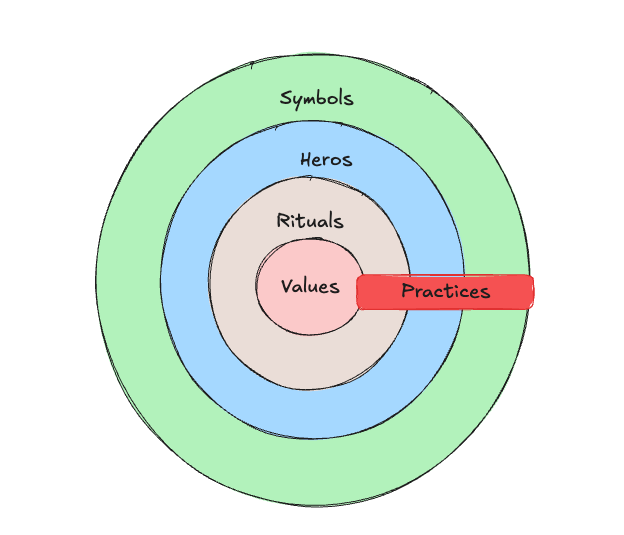
Layers of Culture

Symbols

The outer layer of culture is Symbols: These are words, gestures, objects, pictures, etc. that carry a particular meaning.

Your company logo is one among them; the way you treat the people, how you communicate those, etc, defines the symbols in your company.

Heros

There are real or fictional persons, in the past or present, who stood for the group or company. They serve as the model behavior.

This could be anyone in our company who stood and fought for the values of your company. You need a heroic story of a group of people or a person, or a project that you can quote and remind people that this is how we used to do this and this is how we will continue evolving. This will be passed on to the generations to come, and that will help cement the culture.

Rituals

These are collective activities; these are social necessities. Sometimes these are not necessary in reaching the objective. Like ways of greeting, showing respect, ceremonies etc.

In your company, this could be your stand-ups, town halls, how you greet each other, how you conduct meetings, when, and how.

Values

This is the core of every culture. These are states of affairs that define Good & Bad, Right & Wrong,etc. Values can only be inferred from the way people act under different circumstances.

If you look at the diagram, culture is like the layers of an onion. When you start peeling away the layers in search of the “real” onion, you won’t find it — because those layers are the onion.

In the same way, without all of these layers, there is no culture.

The visible aspects of culture are its symbols, heroes, and rituals, and these are the elements we can see, hear, or observe in everyday practice. The real meaning behind these things is connected to values, beliefs, and practices. This drives emotions, and this is invisible and intangible.

In the world of Agents, Humanoid robots, and GenAI, it will be difficult to create these emotions. So how are you going to create a culture, or how are you going to keep your culture intact? 

As we discussed earlier, culture is something that is possessed and followed by only humans. In the new world, the leaders of the companies are going to play a more important role than before in determining and making sure the company is staying true to the culture.

Some of the changes that are going to happen are:

1. Companies don’t need a big team

This is a sad truth for some, but the reality is we don’t need big teams to deliver a project anymore. Fewer people to manage, fewer meetings to survive… project managers might actually be smiling at this one 🙂 .

This means that your heroes or heroic stories of projects have to come from this small group. The leaders in these projects have to stay true to the company culture.

2. More Agents:

Agents will be deployed not just on the dev side but also in all aspects of business, from customer service to reporting to operations, to content, and to almost every aspect of business.

You need to inject the symbols and values into these agents. You should be tuning and training your customer service agent to keep the tone of voice the same as the brand does. The content agent should be generating the content, keeping the brand values in place. The operational agent should control the operations, keeping the process, tone, and methods aligned to the brand’s values and cultures.

If you just roll out an agent without defining and fine-tuning this, then its going to kill your culture.

In order to make sure this is in place, you might have to write Evals, track them, and optimize them continuously.

3. Resources in Payrol Vs Resource on Demand

I believe that as agents continue to evolve and mature, companies will start relying on fewer full-time employees. Instead, they’ll increasingly onboard talent on a project or product basis, releasing them once the work is complete. Much of the work previously handled by these roles will soon be automated by intelligent agents. As a result, organizations will view this shift as an opportunity to significantly reduce operational costs.

From a cultural perspective, this shift poses a potential threat. As people join from different backgrounds, collaborate for short engagements, and then move on, maintaining a consistent culture becomes challenging. Therefore, clearly defining and reinforcing your company’s practices and rituals in every project will be crucial.

However, these practices shouldn’t feel rigid or imposed — they should naturally integrate into the way of working within each project. If you fail to define them, individuals from diverse environments will bring their own ways of working, and over time, your organization may lose its unique identity and culture.

3. Mini-Culture for every project

Since every project is going to onboard different people at different points of time. You need to have a mini culture that fits the delivery. This should be a subset of your company culture that is consistent in values but flexible in execution.

For example, if your company defines a development process, it shouldn’t be overly rigid. The process should outline what needs to be done, not dictate how it must be done.

Think of it like:

Instead of saying, “You must eat three meals a day — breakfast, lunch, and dinner — and breakfast must be a three-course meal with specific dishes,” you simply set the expectation that “You must have three healthy meals a day.”

This allows individuals the freedom to choose what and how they eat, based on their context and availability, while still aligning with the core intent of staying healthy.

Now, bringing this back to your project, defining a process like this helps ensure that every team carries out a code review. But the format and who conducts it can change based on the systems, platforms, and technologies involved.

How can you preserve your culture?

All the best!

(Not joking — it’s not going to be easy, especially for those self-proclaimed “great culture” champions.) The real test begins now.

Your leaders and senior folks will have to step up and play a truly crucial role. Maybe take another look at that onion diagram and honestly reflect on what needs to change — the how and the why.

I believe this is something that we have to carefully consider, even when we are racing to keep up the pace. What do you think?

Where Are The Real People?

These days, we connect with friends, family, and colleagues through digital media. We are proud that we are always connected and and these days, there are countless ways to stay connected. We are proud of adding more and more connections to our network. In the world of social media, we are getting addicted to follows, likes, feelings in the shape of the heart & different icons, the count of connections, etc.

But somewhere, somehow, we forget where the real people are. Are we even connected to them? Or how many genuine connections, friends, follows, hearts, or many of those emojis do we own?

This begs the question: Where are the real people? This sets me into a quest to understand who they are, where they might be, and why do they seem so hard to find and I’m willing to bet you’ve had moments too — times when you’ve wondered the same, faced situations that made you question what’s real and who’s truly genuine.

To the world, you are what you appear — But only a few glimpse who you truly are

Have you ever looked at someone in a position of power and thought, “How on earth did they get there?” We’ve all witnessed it. People who seem thoroughly incompetent are rising to positions of authority while more capable individuals remain stuck in the shadows. Why is this happening? First, I thought this was something that started happening recently. Then I stumbled upon the studies of “Niccolo Machiavelli,” an author, philosopher, and historian who lived during the Italian Renaissance. He is best known for his political treatise The Prince, written around 1513 but not published until 1532, five years after his death.

That book is not merely an ancient philosophy — it’s a real psychological force and mindset that shapes our world from boardrooms to politics.

Unlike the other philosophers, Machiavelli wasn’t concerned with how rulers should behave in a perfect world. Instead, he focused on how power actually worked in the real world. He understood that perception always matters, and that is the way to control the crowd. “To the world, you are what you appear — But only a few glimpse who you truly are.” This is the key.

“Appearing competent is often more important than actually being competent”.

Machiavelli observed that rulers who display too much intelligence often create problems for themselves. Because intelligence usually comes with certain traits that can become liabilities. Traits like critical thinking, ethical considerations, and self-awareness.

Imagine what happens when a genuinely intelligent person enters a power structure. They tend to see complexities where others see simplicity, they point out limitations where others make blanket promises, they question themselves and the choices we make, whereas others project absolute confidence in everything they say or do.

This is where you might notice that the loudest voice that simplifies situations becomes most influential. Why is this happening?

In the 1990s, psychologists David Dunning and Justin Kruger identified what we now know as the Dunning-Kruger effect, the cognitive bias 

The people with limited knowledge in a particular domain overestimate their ability /competence, while genuine experts tend to underestimate their awareness of how much they don’t know !

Like Socrates used to say, “I know that I know nothing,” this made him a philosophical genius, but ultimately sentenced him to death by the Athenian democracy.

You could see this in politics and in the tech industry. The politician who claims to have solutions to everything and the founders who speak in absolute visionary terms often secure massive funding and support over more measured, experienced counterparts. 

The self-proclaimed leaders, Me Me Culture or Narcissism

Narcissism and non-competence are the strongest predictors of who emerges as a leader in unstructured groups. This is not my statement, it is from 2012 researchers at Stanford and the University of Houston. They found that the groups that were led by these narcissists didn’t win; they just thought they were winning.

The confidence signals and cognitive bias help these incompetent individuals initially rise to power.

Machiavelli observed something crucial about power structures: incompetent leaders tend to surround themselves with even less competent subordinates. In “The Prince,” Machiavelli wrote, “The first method for estimating the intelligence of a ruler is to look at the men he has around him.” The weak leaders deliberately select weaker subordinates to ensure they never face threats to their authority. You might have observed the same around you in politics, in corporations, organizations etc.

Reality Vs Certainty

When dealing with real-world problems, uncertainty is real, and that is the reality. We can’t predict what exactly will happen. But according to human psychology, we crave certainty even when certainty isn’t possible. Because of the same reason, when in crisis, either a political crisis or a project crisis, people rally behind the leader who says, ‘I can fix this, and I alone can fix this’. But the reality is that the complex situations with no easy answers will require careful thought and inevitable trade-offs instead of self-proclamations. You might have seen incompetent people rise to power and fall flat on their faces. The world has seen this during the COVID-19 pandemic. 

The political figures and leaders who offer simplistic solutions and promise everything with no downsides will win public support. Those who offer everything with certainty, regardless of feasibility, are jarring.

These days, these kinds of leaders and solution providers are everywhere you can see them in politics, in corporations, on social media, and LinkedIn is no exception.

Fake personas all over.

University of British Columbia researchers found that psychopathic traits like, lack of empathy, were positively associated with rapid advancement when combined with social charm.

Studies conducted in corporate offices show that “manipulative leaders often outpace their intelligent, moral, ethical peers”. Game theorists call this “A race to the bottom, when unethical tactics prove successful, others face pressure to adopt similar approaches or be left behind over time. This can transform entire systems, making unethical behavior the norm rather than the exception. This is a serious issue — we are normalizing extreme thinking & intolerance, which in turn fuels sociocultural conflicts and violence. This trend can be observed across nearly every country around the world.

You might have even noticed a version of this on LinkedIn. In the initial days, those who created a persona of an expert on LinkedIn started landing jobs. Fast forward to now, LinkedIn is full of experts, and it’s difficult to find the real ones.

Machiavelli recognized that most people evaluate others based on surface impressions rather than deep understanding, especially in complex domains where few have the expertise to make informed judgments. He said, “Systems that reward short-term performance over long-term outcomes create fertile ground for incompetent leadership with superficial charm.

Machiavelli has been misunderstood for centuries. He wasn’t advocating for the dark patterns instead, he was describing and exposing them by understanding how power actually works. He believed we could create better systems of governance if it’s not titles that honor men, but men that honor titles. This profound observation reminds us that authority itself deserves no inherent respect. Power must be earned through worthy use, regardless of who holds it.

The intersection of Machiavellian political philosophy and modern psychology reveals uncomfortable truths about human nature and social systems. The uncomfortable truths are precisely what we need, if we hope to create a better future. The path forward isn’t pretending these dynamics don’t exist; it’s understanding them deeply enough to transcend them. It’s designing systems that account for human vulnerabilities rather than exploiting them. It’s developing personal practices that strengthen our resistance to manipulations. Most importantly, 

It’s recognizing that while stupidity may sometimes gain power, intelligence coupled with moral courage remains our best hope for creating societies where merit truly matters.”

Reference materials:

The prince by Niccolo Machiavelli

Dunning-Kruger effect by the psychologists David Dunning and Justin Kruger

Research materials from Stanford and the University of Houston

Research about psychopathic traits in humans from various research materials and universities like the University of British Columbia, and other psychology papers

Surface scratching basics about Game Theory

Impact of Cognitive Bias on people and decision making 

Many YouTube videos on these research papers