
Culture, a word we are so proud of.
Every society and every company is proud of its culture and believes that it is the epitome. Like, some companies with truly questionable cultures also claim they are the epitome of culture.
Have you ever wondered what this culture is and how it forms and shapes?
The most famous definition of culture is by the English anthropologist Edward Burnett Tylor.
“Culture is a complex whole encompassing knowledge, beliefs, art, morals, laws, customs, and other capabilities and habits acquired by individuals as members of society.”
If you examine the cultures, this is something that is unique to humans; no other animals possess this. Rest, all animals have behavioural traits and not cultural traits.
That is one non-debatable topic that only humans possess culture. With the GenAI and humanoid robotic era non-humans are going to enter our workspace or already are in our workspace.
How are businesses and companies that are so proud of their culture going to handle this? How are you going to teach your company culture to GenAI?
Let’s look at the layers of culture:
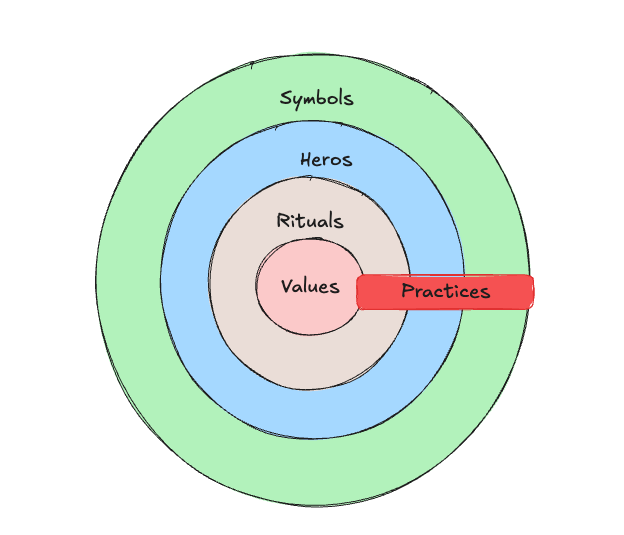
Symbols
The outer layer of culture is Symbols: These are words, gestures, objects, pictures, etc. that carry a particular meaning.
Your company logo is one among them; the way you treat the people, how you communicate those, etc, defines the symbols in your company.
Heros
There are real or fictional persons, in the past or present, who stood for the group or company. They serve as the model behavior.
This could be anyone in our company who stood and fought for the values of your company. You need a heroic story of a group of people or a person, or a project that you can quote and remind people that this is how we used to do this and this is how we will continue evolving. This will be passed on to the generations to come, and that will help cement the culture.
Rituals
These are collective activities; these are social necessities. Sometimes these are not necessary in reaching the objective. Like ways of greeting, showing respect, ceremonies etc.
In your company, this could be your stand-ups, town halls, how you greet each other, how you conduct meetings, when, and how.
Values
This is the core of every culture. These are states of affairs that define Good & Bad, Right & Wrong,etc. Values can only be inferred from the way people act under different circumstances.
If you look at the diagram, culture is like the layers of an onion. When you start peeling away the layers in search of the “real” onion, you won’t find it — because those layers are the onion.
In the same way, without all of these layers, there is no culture.
The visible aspects of culture are its symbols, heroes, and rituals, and these are the elements we can see, hear, or observe in everyday practice. The real meaning behind these things is connected to values, beliefs, and practices. This drives emotions, and this is invisible and intangible.
In the world of Agents, Humanoid robots, and GenAI, it will be difficult to create these emotions. So how are you going to create a culture, or how are you going to keep your culture intact?
As we discussed earlier, culture is something that is possessed and followed by only humans. In the new world, the leaders of the companies are going to play a more important role than before in determining and making sure the company is staying true to the culture.
Some of the changes that are going to happen are:
1. Companies don’t need a big team
This is a sad truth for some, but the reality is we don’t need big teams to deliver a project anymore. Fewer people to manage, fewer meetings to survive… project managers might actually be smiling at this one 🙂 .
This means that your heroes or heroic stories of projects have to come from this small group. The leaders in these projects have to stay true to the company culture.
2. More Agents:
Agents will be deployed not just on the dev side but also in all aspects of business, from customer service to reporting to operations, to content, and to almost every aspect of business.
You need to inject the symbols and values into these agents. You should be tuning and training your customer service agent to keep the tone of voice the same as the brand does. The content agent should be generating the content, keeping the brand values in place. The operational agent should control the operations, keeping the process, tone, and methods aligned to the brand’s values and cultures.
If you just roll out an agent without defining and fine-tuning this, then its going to kill your culture.
In order to make sure this is in place, you might have to write Evals, track them, and optimize them continuously.
3. Resources in Payrol Vs Resource on Demand
I believe that as agents continue to evolve and mature, companies will start relying on fewer full-time employees. Instead, they’ll increasingly onboard talent on a project or product basis, releasing them once the work is complete. Much of the work previously handled by these roles will soon be automated by intelligent agents. As a result, organizations will view this shift as an opportunity to significantly reduce operational costs.
From a cultural perspective, this shift poses a potential threat. As people join from different backgrounds, collaborate for short engagements, and then move on, maintaining a consistent culture becomes challenging. Therefore, clearly defining and reinforcing your company’s practices and rituals in every project will be crucial.
However, these practices shouldn’t feel rigid or imposed — they should naturally integrate into the way of working within each project. If you fail to define them, individuals from diverse environments will bring their own ways of working, and over time, your organization may lose its unique identity and culture.
3. Mini-Culture for every project
Since every project is going to onboard different people at different points of time. You need to have a mini culture that fits the delivery. This should be a subset of your company culture that is consistent in values but flexible in execution.
For example, if your company defines a development process, it shouldn’t be overly rigid. The process should outline what needs to be done, not dictate how it must be done.
Think of it like:
Instead of saying, “You must eat three meals a day — breakfast, lunch, and dinner — and breakfast must be a three-course meal with specific dishes,” you simply set the expectation that “You must have three healthy meals a day.”
This allows individuals the freedom to choose what and how they eat, based on their context and availability, while still aligning with the core intent of staying healthy.
Now, bringing this back to your project, defining a process like this helps ensure that every team carries out a code review. But the format and who conducts it can change based on the systems, platforms, and technologies involved.
How can you preserve your culture?
All the best!
(Not joking — it’s not going to be easy, especially for those self-proclaimed “great culture” champions.) The real test begins now.
Your leaders and senior folks will have to step up and play a truly crucial role. Maybe take another look at that onion diagram and honestly reflect on what needs to change — the how and the why.
I believe this is something that we have to carefully consider, even when we are racing to keep up the pace. What do you think?

 Trooming